Get the most current Rental Application form now and subscribe to download
A rental application form is a formal document used by tenants who are interested in renting a residential/commercial property. The main purpose of this document is to provide landlords with complete information and demonstrate why you are a good fit for a particular rental unit.
On our platform, you will find a complete rental application form that you can fill out, edit, and sign online, without installing software. Use our form to create a strong application and increase your chances of passing tenant screening.
What Is a Rental Application Form?
A rental application form, also known as a tenant application form, is a document provided to a landlord/property manager by a potential tenant to provide their personal and financial information for screening before signing a lease. Don’t mistake it with a lease agreement – unlike it, a rental application form is just a screening tool.
Using rental applications is a common practice across all US states. These documents are meant to create a clear and secure rental process for both sides and support fair decision-making. They are used for different lease situations, including residential and commercial ones.
Rental Application vs. Lease Application (Agreement)
A rental application and a lease agreement are two distinct documents that shouldn’t be mistaken. A rental application is a document that precedes any factual agreements. Landlords and property managers use it to evaluate prospective tenants and make an informed decision on whether they should lease the property to them or not. A lease agreement is the final, legally binding contract signed by a tenant and landlord after approval.
Here’s how these two documents differ:
When is it used? | |
Rental Application | BEFORE an approval; the application is submitted for tenant screening prior to agreeing on a lease. |
Lease Agreement | AFTER an approval; the agreement is signed after a successful screening and finalization of the decision. |
Sequence of steps | |
Rental Application | A tenant views a rental unit → They complete an application and submit it to a landlord → The applicant pays a screening fee and waits for the landlord’s decision |
Lease Agreement | A landlord evaluates an applicant and approves them → They or their real estate agent/legal representative create a lease agreement with specific rental terms → Both a landlord and an approved tenant check the lease provisions and sign an agreement → The tenant pays deposits and first-month's rent and receives the keys |
Who signs the document? | |
Rental Application | Only a prospective tenant, to validate the information they provide in the form and give consent for background/credit checks. |
Lease Agreement | Both a tenant and a landlord/property manager; to confirm the agreed-upon terms, rights, and responsibilities |
Legal status | |
Rental Application | A screening document and formal consent. Not a legally binding contract. |
Lease Agreement | A legally binding contract. Violating its provisions is considered a legal breach of contract. |
Types of Rental Applications
Rental applications are common both in residential and commercial leases, and they apply to different property types. Here’s a brief overview of this document’s types by property:
Standard residential rental application: These applications are submitted by tenants interested in renting residential property, such as an apartment, house, or condo. Regardless of the property type, such applications include basic personal data, previous rental history, employment history, and proof of steady income.
Student housing application: These applications are used in the process of renting private shared apartments, purpose-built student accommodation, and studio flats by students. Since they are student-specific, these documents must include proof of student status along with general personal information. Also, since many students lack an extensive credit and rental history, student housing applications may include financial verification of a guarantor, not the student themselves.
Room rental application: A highly specific form used when applying to become a roommate in a shared flat. Unlike a traditional residential rental application, this document focuses on personal habits and lifestyle compatibility apart from basic personal and financial information.
Commercial property application: These applications are submitted when a business or legal entity applies to rent a commercial space (e.g., a warehouse or a retail store). A commercial lease application must provide corporate entity verification data and credit history, financial statements, and tax returns of the business instead of sharing personal data.
What Information a Rental Application Includes
A standard rental application form must contain four essential types of data: personal information, rental history, employment and income, and personal references. All these details are meant to help landlords evaluate whether a prospective tenant suits their expectations and can meet rental obligations. Additionally, the form should provide explicit consent for background and credit checks.
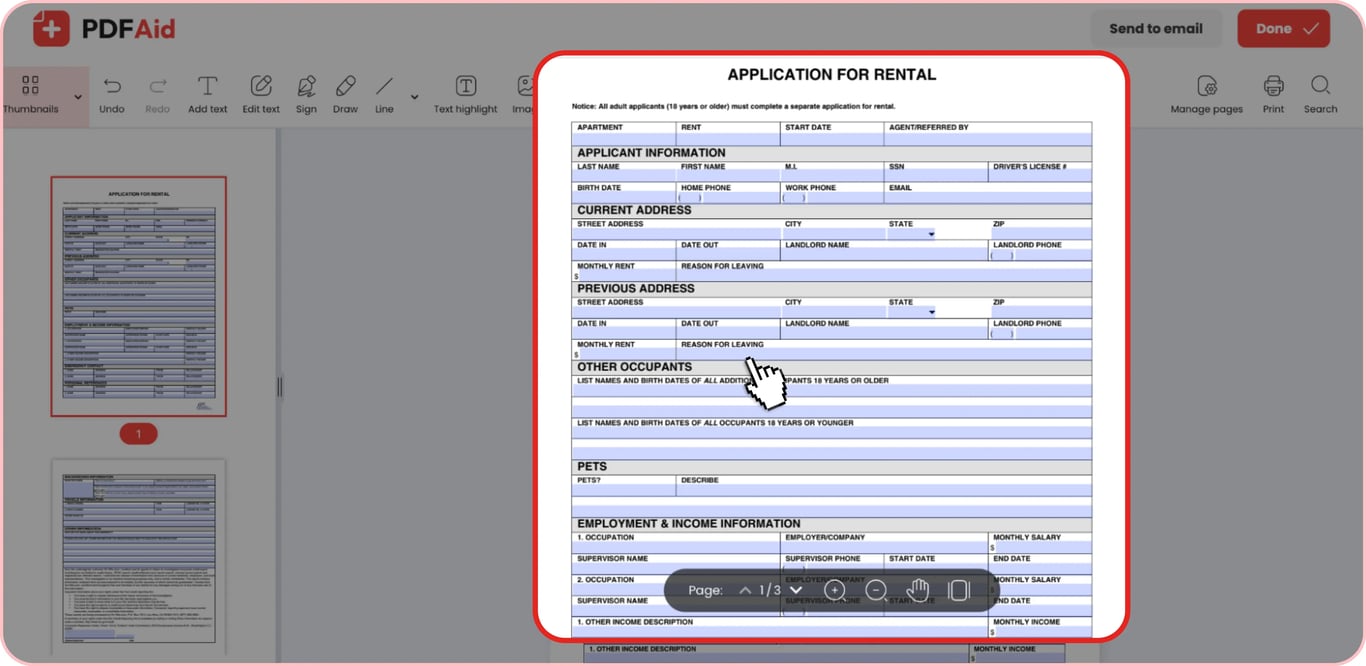
Personal, Employment & Income Details
In the first part of the rental application, potential tenants must provide their full personal, employment, and income details:
Form Section | Applicant information |
|---|---|
What to Put on a Rental Application |
|
Form Section | Current address |
|---|---|
What to Put on a Rental Application |
What to put on a rental application if living with parents:
|
Form Section | Previous address |
|---|---|
What to Put on a Rental Application |
|
Form Section | Other occupants |
|---|---|
What to Put on a Rental Application |
|
Form Section | Pets |
|---|---|
What to Put on a Rental Application |
|
Form Section | Employment & income information |
|---|---|
What to Put on a Rental Application | For each position:
For additional sources of income:
|
What not to put on a rental application:
Fabricated or misleading information
Protected statuses, such as race, color, national origin, religion, sex, familial status, and disability.
Sensitive details, such as unmasked SSN (until you verify a landlord and agree to background checks), passwords, and PINs
Blank contact fields in the employment and rental history sections
Proof of income for rental application: Most landlords will expect that the monthly rent makes up no more than 30% of your gross monthly income. To confirm the data you provide in the employment/income section and validate your financial stability, they will likely request proof of income – financial documents covering the last 2-3 months (e.g., pay stubs, tax returns, a signed employer offer letter, etc.).
Credit & Personal References
The references section of a rental application is meant to give a landlord/property manager specific contacts to verify your personal reliability and the factual information you provide in the document. You can list two types of references:
Credit reference: A person, institution, or historical record that confirms your financial reliability and payment history. Landlords check such references to ensure that you pay your bills on time.
Who can be included:
Previous landlords
Financial institutions where you have active accounts and are in good standing
Utility companies you’ve dealt with
Financing or loan providers
Guarantors with strong financial profiles who are ready to back up your obligations
Personal reference: Individuals who can vouch for you personally. They should be able to confirm your lifestyle habits, character, trustworthiness, and behavior.
Who can be included:
Family friends (but not immediate family members)
Teachers, professors, and mentors
Roommates
Colleagues
Employers and supervisors (both previous and current)
Coworkers
Traditionally, an application should include 2-3 references total and at least 1 professional/rental history reference. Keep in mind that you will likely provide references to your current or past landlord in the current and previous address sections and employer/supervisor references in the employment section. So you only need to include 1-2 personal references in the standalone reference section.
Background & Credit Check
Tenant screening is a formal security procedure that follows a rental application. During the screening, landlords and property managers perform an all-around background check, which involves:
Identity verification: General confirmation of the applicant’s identity and SSN.
Criminal background check: Search of public criminal records related to misdemeanor or felony convictions. As overly broad criminal-history screening may raise Fair Housing concerns, landlords should consider the relevance of the record and check not only the presence of a criminal record but also evaluate the nature, severity, and recency of the offense.
Credit history and debt performance: A complete analysis of a tenant’s credit report, loan repayment history, bankruptcies, etc.
Bank statement disclosures: A collection and analysis of the applicant’s bank statements to evaluate cash reserves, income consistency, and current balances.
Rental and eviction history: Search of eviction filings, judgments, or landlord-tenant disputes in court registries and by contacting references.
Since the Fair Credit Reporting Act (FCRA) requires landlords to have a permissible purpose for obtaining a consumer report, a legally sound rental application should include a written statement that authorizes the landlord and its agents to investigate the applicant’s credit history and perform OFAC, landlord/tenant court record, and criminal record searches.
How to Fill Out a Rental Application Online
If you are getting ready to apply for housing, our platform gives you a complete fillable PDF form that you can easily edit and sign online. Follow these steps:
Go to the Rental Form page on our platform and click Get Form. Our PDF editor will instantly open a form that you can fill out.
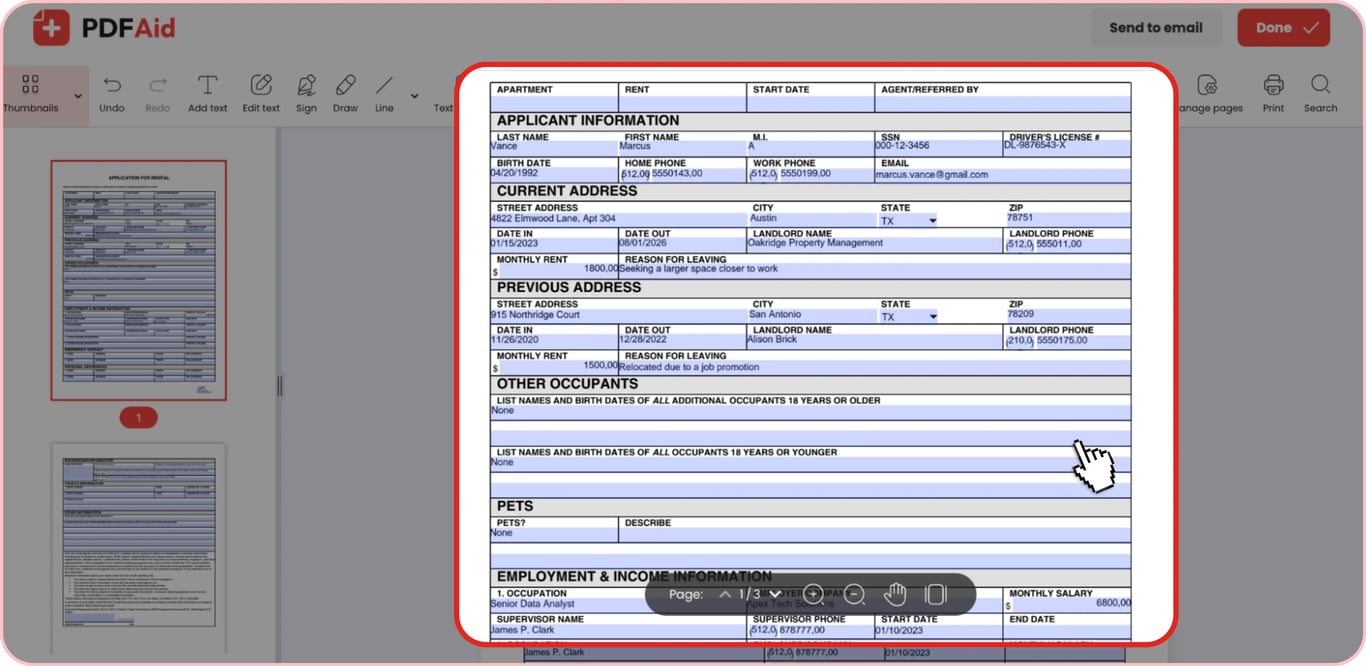
Fill out the form section by section, providing valid and current personal, employment, and income details. Pay special attention to your credit data – the information that refers to your financial reliability. Here’s how to fill out credit information on a rental application:
Type your full legal name, exactly as it appears in your ID.
Type your SSN accurately, avoiding errors and typos.
Indicate a current and previous address.
Add your signature and date under the authorization statement to let the landlord perform credit checks.
Add emergency contacts and personal references to relevant sections.
Complete the Background Information section, answering questions about bankruptcy, evictions, and crime convictions.
If you own any vehicles, complete the Vehicle Information section. Specify the make & model, year, license number, and state data for each vehicle.
In the Other Information section, provide an explanation of how you heard about the property you are interested in. Then, include additional information that can help the landlord evaluate your application.
Carefully check all the provided information.
Click Done in the upper right corner, name your file, and export it as a PDF to save a copy.
Signing the Application & Adding a Cosigner
Once you fill in the form and check all details, you can instantly sign it right in our editor, following these steps:
Open a filled-out document in our editor.
Go to the bottom of the second page to find a signature field under the background check authorization statement. Click Sign and draw, upload, or type your signature, and type the date of signing next to a signature.
Go to the bottom of the third page, click Sign, and add your signature again. Type your full name and date under the signature.
Add your initials next to the two following statements if you’d like to receive copies of any investigative consumer report and any credit report received by the landlord in the process of checks.
Click Done and save a copy of a signed application.
If you’re making a co-signer rental application:
A co-signer (guarantor) is a creditworthy third party who agrees to take responsibility for specified lease obligations if the primary tenant fails to meet them. You might need a co-signer if you have insufficient income, a poor (or limited) credit score, employment instability, or a lack of rental history.
Example:
A student has their parents co-sign their lease or credit application.
There are two ways to add a guarantor:
Add them as a co-signer
Add a co-signer addendum to your application
Rental Application Fee
A rental fee is a one-time charge collected by a landlord from an applicant. Its purpose is to cover out-of-the-pocket costs of tenant screening.
The actual size and refundability of a renting application fee are governed by state laws, so be sure to check the current laws in your jurisdiction.
How Much Is a Rental Application Fee?
The size of an application fee can range from $30 to $70, depending on the state. According to Zillow, $50 is considered a standard nationwide fee size. However, some states enforce legal caps on the size of the fee. For example:
New York – The fee should not exceed $20
Wisconsin – A landlord may charge the actual cost, up to $25, for obtaining a qualifying consumer credit report.
Delaware – The fee should not exceed $50 or 10% of the monthly rent, whichever is greater.
When the landlord requests a fee, don’t hesitate to check if your state has any limits on its size to ensure that you receive a lawful request.
Are Application Fees Refundable?
The refundability of an application fee depends on two primary factors: the status of your application and state laws. In many cases, a fee is non-refundable if a landlord actually runs a tenant screening on you. In this case, the fee covers the factual out-of-pocket costs. However, if you pay your fee and the landlord rents the unit before checking you, it might be refundable in certain states.
Other possible refundable cases:
The rental unit is withdrawn from the market;
The rental unit was never actually available for rent;
The portion of your fee remained unused (in Washington, Minnesota, or California, this can mean that you can request a return of the unused portion).
Other possible non-refundable cases:
The screening was carried out, but your application was denied based on the results;
You voluntarily withdraw from the deal after a screening and approval;
You apply in a state that does not impose a statewide cap on rental application fees (e.g., Texas or Florida).
If you’re applying in California, you also must know that this state has some of the strictest fee regulations. California law sets a CPI-adjusted maximum application screening fee under Civil Code section 1950.6. The Assembly Bill 2493 also added rules on when landlords may collect the fee, how applications are considered, and when fees must be refunded. According to the AB 2493:
The landlord must provide an itemized receipt for the fee;
The landlord must deliver a copy of the pulled credit report;
The landlord must refund the fee or any unused portion when required by the screening and refund rules in Civil Code section 1950.6.
To secure your application fee, consider outlining a fee policy in your application. It can look like this:
“The one-time screening fee of [$XX] is collected solely to cover the actual, out-of-pocket costs of credit and criminal background checks. If the checks are not performed due to the approval of a prior applicant, the full amount of the fee shall be refunded to the applicant within [X to X] business days.”
How Long Does a Rental Application Take?
Landlords often take 24 to 72 hours to process rental applications. However, the exact waiting time can vary. The main affecting factors include:
The completeness of your application: If your application has many blank fields, the landlord might need to spend extra time to clarify the necessary details.
The time references take to respond: If your previous landlords or other references are not available, it can add extra time to the process.
The availability of the necessary supplemental documents: Delivering your ID, pay stubs, and other documents upfront helps reduce back and forth and speed up the process.
The total pool of applicants interested in a particular rental unit: The higher the competition, the more time the landlord might need to process all applications.
The involvement of a co-signer: If there is a guarantor, the landlord might need additional time to perform screening on them as well.
The screening methods the landlord uses: Automated screening tools typically give faster results than manual checks.
Approving or Denying a Rental Application
After you submit an application and supplemental documents, the landlord will take their time to review the application details and perform background checks. The final decision is made based on a comparison of the applicant’s profile against the expectations and standards of the landlord.
Although each situation can have its unique specs, the general decision-making logic is the following:
Can the applicant actually afford a particular rental unit? – The answer is shaped based on the gross monthly income, additional income sources, and employment stability.
Will they pay it timely and diligently? – The answer is shaped based on the past rental history, previous landlords’ recommendations, evictions, late payment history, etc.
Are they a safe bet? – The answer is shaped based on criminal records, credit references, and personal references.
What Happens After Approval (and 'changed mind' cases)
Traditionally, after a rental application is approved, you will receive a notice about this from the landlord. The next steps:
Preparing a lease agreement
Signing it
Paying the deposit and first month’s rent
Receiving the keys
Moving in
In some cases, the deal gets canceled because the landlord changes their mind after the rental application is approved. Then, your actions depend on the lease agreement status.
If it’s not signed yet:
Demand an immediate refund of any deposits and rent you’ve already paid.
Rarely: claim promissory estoppel (if you relied heavily on the landlord’s approval).
If you believe that it’s a discrimination case (e.g., the landlord changed their mind after learning about your familial status or race), file a complaint with the U.S. Department of Housing and Urban Development.
If it’s signed:
Send a formal written demand to give you the keys, referring to your contract.
File a lawsuit for breach of contract.
If the Application Is Denied (denial & rejection letters)
Federal law does not always require a formal denial notice, although state or local laws may impose additional notice requirements. If a consumer report influences a landlord’s decision to deny an application or impose less favorable terms, the FCRA requires an Adverse Action Notice. The notice must include the following data:
Information about the screening company
An explicit statement that the final decision was not made by the screening company
Guidelines for obtaining a free copy of your reports
A statement of your right to dispute inaccurate information in the report
If you don’t receive any notice and don’t hear back within 5-7 business days after application, you can clarify its status by politely reaching out to the landlord or property manager. If they confirm the denial, you can ask them about the reason. Common reasons to reject an application include:
Insufficient income
Poor or limited credit score
Negative rental history
Incomplete application or false information
Occupancy limits of the property
In no case can the denial result from discrimination based on race, color, national origin, religion, sex, familial status, or disability.
If you are a landlord denying an application, the right way to do this is by delivering a polite, objective, and legally compliant denial letter. It's important to ensure that your rejection reason is valid and does not violate the Fair Housing Act.
Here’s a template of a solid rental application denial letter:
Subject line: Rental Application for [rental unit address]
Message:
Dear [applicant’s name],
Thank you for taking an interest in renting the property located at [full address]. We appreciate the time you took to submit the rental application and supplemental documentation.
After thorough evaluation of your application, we regret to inform you that we are unable to approve your application at this time. This decision was based on:
[objective criteria, e.g., insufficient monthly gross income, unfavorable references, etc.]
Wishing you the best of luck in your home search.
Kind regards.
[Sender’s name and contact details]
Get the most current Rental Form form now
Up-to-date • Fillable • Ready to sign online