Get the most current W9 form now and subscribe to download
Form W-9 is what companies use to get tax information from freelancers and independent contractors. Fill out, modify, and sign your printable W-9 form directly in a browser with our online editor. When you are done, you can download or email the form.
What is a W-9 form?
The W-9, Request for Taxpayer Identification Number and Certification, is used to gather correct tax information. This form must be filled out by freelancers, independent contractors, and vendors working for businesses. The company paying for these services (Requester) has to collect tax information.
Facts about Form W-9:
Purpose: to give tax information to the person or company paying you.
Who uses it: self-employed professionals, freelancers, consultants, and independent vendors.
Who is asking for it: a business, organization, or bank that makes reportable payments to a contractor.
Current version: the most recent approved edition is the March 2024 update and is the version to be used for 2026.
What it is not: It does not report annual income, calculate taxes, or replace a tax return.
W-9 form fields explained
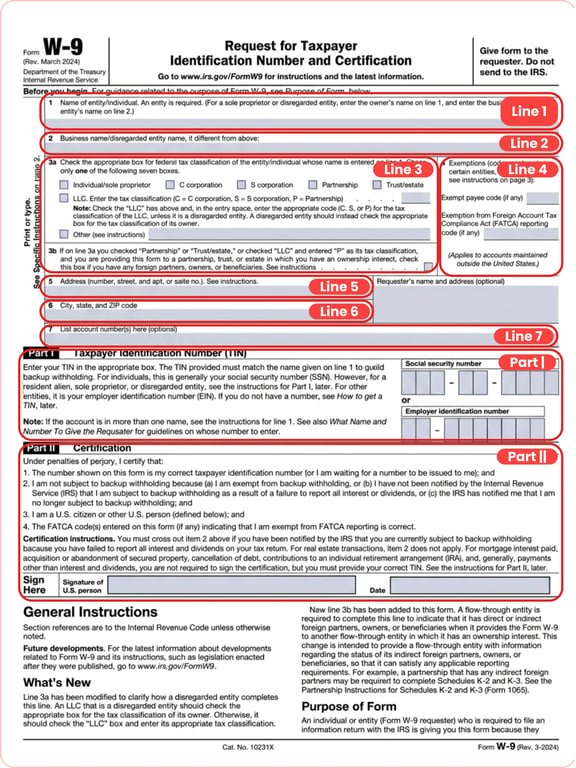
The official W-9 certificate requires you to fill out several fields line by line:
Field | Line 1 |
|---|---|
What to Enter | Your official name. |
Field | Line 2 |
|---|---|
What to Enter | Your business, trade, or DBA name, if it differs from your legal name. |
Field | Line 3 |
|---|---|
What to Enter | Your federal tax classification. |
Field | Line 4 |
|---|---|
What to Enter | Exempt payee or FATCA codes if you are exempt from backup withholding. |
Field | Lines 5–6 |
|---|---|
What to Enter | Your mailing address. |
Field | Part I |
|---|---|
What to Enter | Your Taxpayer Identification Number. |
Field | Part II |
|---|---|
What to Enter | Your signature and the date for withholding status certification. |
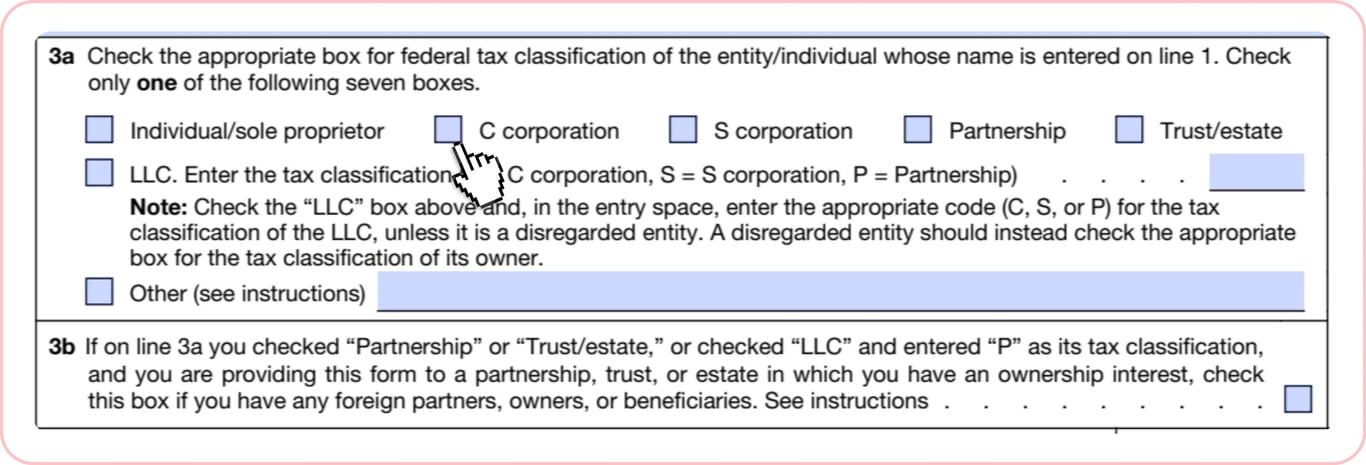
Federal tax classification (individual, LLC, C/S-corp, disregarded entity)
Whether you're completing an individual or a company W-9, check only one box on Line 3 for your legal tax status:
Individual/Sole Proprietor: Select this if you are an individual, sole proprietor, freelancer, or independent contractor working under your own name.
C Corporation: Select this if your business is incorporated and taxed as a C Corporation.
S Corporation: Select this if your business is incorporated and the IRS has approved your S corporation status.
Partnership: Select this if your business has multiple owners and files as a partnership.
Trust/Estate: Select this if you are completing the form on behalf of a trust or an estate.
Limited Liability Company (LLC): Select this if your business is a multi-member LLC or an LLC. In the blank space, write C for a company taxed as a corporate entity, S for an S corporation, or P for a partnership.
Single-Member LLC (Disregarded Entity): Do not check the LLC box if you are the sole owner. The IRS treats single-member LLCs as disregarded entities. Instead, check the "Individual/Sole Proprietor" box. Put your name on Line 1 and your business name on Line 2.
Other: Use this option only if your classification is not stated. Write your specific tax status in the space provided.
Exempt payee code & backup withholding
Line 4 contains an exempt payee code and a Foreign Account Tax Compliance Act (FATCA) reporting code. The exempt payee code shows that your payments are free from automatic tax withholding. The FATCA code applies only to businesses with financial accounts outside the United States. Most freelancers and sole proprietors leave Line 4 blank because they do not qualify for the exemptions.
If you don't qualify for an exemption, the payer may withhold 24% of certain payments under the IRS backup withholding rules. The payer sends this amount directly to the IRS if you give an incorrect tax number, leave the field blank, or forget to sign Part II.
The IRS uses these codes on Line 4 to identify entities:
Code 1: Tax-exempt organizations under section 501(a), IRAs, or certain custodial accounts.
Code 2: The United States or any of its official agencies.
Code 3: A state, the District of Columbia, a U.S. territory, or any of their political subdivisions.
Code 4: A foreign government, its political subdivisions, or its agencies.
Code 5: A corporation.
Code 6: A dealer in securities, commodities, or derivative financial instruments.
Code 7: A futures commission merchant registered with the Commodity Futures Trading Commission.
Code 8: A real estate investment trust.
Code 9: An entity registered under the Investment Company Act of 1940.
Code 10: A common trust fund operated by a bank under section 584(a).
Code 11: A financial institution as defined under section 581.
Code 12: A middleman known as a nominee or custodian.
Code 13: A trust exempt from tax under section 664 or described in section 4947.
How to fill out a W-9 form
Our online editor allows you to fill out every section digitally without installing extra software. Complete the form fields in order with these instructions:
Step 1. Open the template: Load the fillable Form W-9 in your browser.
Step 2. Enter your legal name on Line 1 exactly as it appears on your tax return.
Step 3. Provide your business name on Line 2 if it differs from your legal name.
Step 4. Select your tax classification on Line 3.
Step 5. Fill out the exemption fields on Line 4 if you qualify for an exempt payee or a FATCA reporting exemption.
Step 6. Enter your address: the city, state, and ZIP code.
Step 7. Input your tax number: Type your Social Security Number or your Employer Identification Number in Part I.
Step 8. Review your information.
Step 9. Download the file: Save the completed PDF document to your device so you can send it to the requester.
Fill out a W-9 as an independent contractor/freelancer
Clients need Form W-9 to prepare your Form 1099-NEC. Fill out your freelance paperwork using these steps:
Name: Enter your name on Line 1 exactly as it appears on your tax return.
Classification: Choose "Individual/Sole Proprietor" as your federal tax classification on Line 3.
Exemptions: Leave fields blank on Line 4.
Tax ID: Provide your Social Security Number (SSN) or Employer Identification Number (EIN) in Part I.
Field | Line 1 |
|---|---|
Example Entry | Emily Carter |
Field | Line 2 |
|---|---|
Example Entry | Carter Creative Studio |
Field | Classification |
|---|---|
Example Entry | Individual/Sole Proprietor |
Field | Address |
|---|---|
Example Entry | 512 Oak Street |
Field | City |
|---|---|
Example Entry | Denver, CO 80204 |
Field | SSN |
|---|---|
Example Entry | 123-45-6789 |
Field | Signature |
|---|---|
Example Entry | Emily Carter |
Fill out a W-9 for an LLC (single-member)
The IRS treats a single-member LLC as a disregarded entity by default unless the business chooses corporate tax treatment.
Follow these steps to complete a W-9 for an LLC:
Name: Enter your personal legal name on Line 1, not the name of the LLC.
Business name: Write the legal name of the LLC on Line 2 if it differs from the owner's name.
Classification: Check the "Individual/Sole Proprietor" box on Line 3.
Exemptions: Leave it blank on Line 4.
Tax ID: Provide the owner's SSN or individual EIN in Part I instead of the LLC's EIN.
Field | Line 1 |
|---|---|
Example Entry | Michael Turner |
Field | Line 2 |
|---|---|
Example Entry | Turner Web Design LLC |
Field | Classification |
|---|---|
Example Entry | Individual/Sole Proprietor (single-member disregarded LLC) |
Field | Address |
|---|---|
Example Entry | 855 River Avenue |
Field | City |
|---|---|
Example Entry | Nashville, TN 37211 |
Field | TIN |
|---|---|
Example Entry | 987-65-4321 |
Field | Signature |
|---|---|
Example Entry | Michael Turner |
Fill out a W-9 as a sole proprietor
An individual sole proprietor reports business income on their individual tax return. Complete the fields with these steps:
Name: Enter your personal name on Line 1.
Business name: Enter your trade or DBA name on Line 2 if you operate under one.
Classification: Check the "Individual/Sole Proprietor" box on Line 3.
Exemptions: Leave fields on Line 4 blank.
Tax ID: Provide your Social Security Number or Employer Identification Number in Part I.
Field | Line 1 |
|---|---|
Example Entry | Sarah Johnson |
Field | Line 2 |
|---|---|
Example Entry | Johnson Photography |
Field | Classification |
|---|---|
Example Entry | Individual/Sole Proprietor |
Field | Address |
|---|---|
Example Entry | 1024 Maple Drive |
Field | City |
|---|---|
Example Entry | Austin, TX 78703 |
Field | SSN |
|---|---|
Example Entry | 555-22-6789 |
Field | Signature |
|---|---|
Example Entry | Sarah Johnson |
Fill out a W-9 for a nonprofit/501(c)(3)
Tax-exempt organizations use a W-9 for nonprofit reporting, securing grants, and business payments. Follow these steps to complete the form:
Classification: Select the appropriate box on Line 3, usually "C Corporation" for nonprofit corporations.
Exemptions: Enter Exempt Payee Code 1 on Line 4.
Tax ID: Enter in Part I the organization's Employer Identification Number.
Signature: An authorized officer or director must sign and date in Part II.
Field | Line 1 |
|---|---|
Example Entry | Helping Hands Community Foundation |
Field | Line 2 |
|---|---|
Example Entry | Helping Hands |
Field | Classification |
|---|---|
Example Entry | C Corporation (501(c)(3)) |
Field | Exempt Payee Code |
|---|---|
Example Entry | 1 |
Field | EIN |
|---|---|
Example Entry | 12-3456789 |
Field | Address |
|---|---|
Example Entry | 250 Charity Lane, Portland, OR 97205 |
Field | Signature |
|---|---|
Example Entry | Jennifer Adams, Executive Director |
Fill out a W-9 as an individual/employee
Individuals receive Form W-9 when providing independent services or receiving reportable payments outside of regular employment.
When completing the form, enter your name on Line 1.
Select "Individual/Sole Proprietor" on Line 3
Provide your Social Security Number in Part I.
Warning: A W-9 employee document is not for payroll or traditional employment. Regular corporate workers do not complete Form W-9 for their employers. They submit Form W-4 instead.
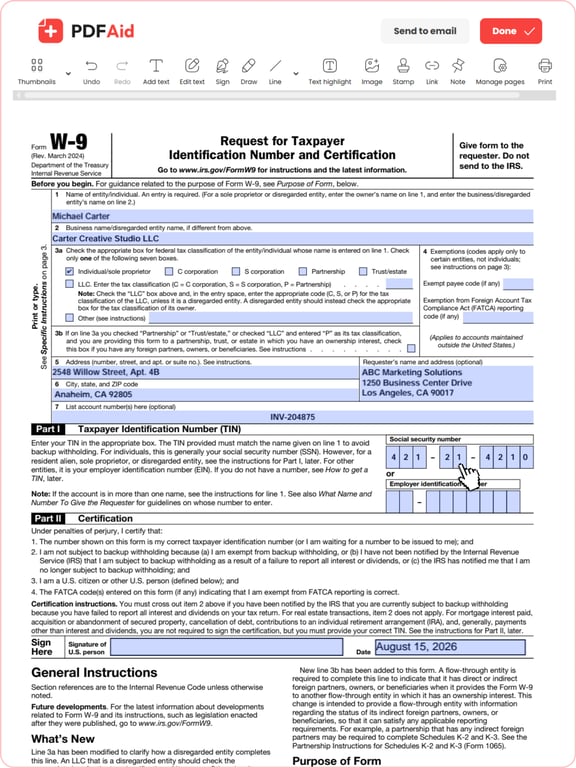
What a completed W-9 looks like
How to sign and submit a W-9 online
Signing Part II is the final step to complete your Form W-9. This signature legally confirms that your tax number is correct. It also proves you are a U.S. person and do not face backup withholding. Requesters will reject the form if it is missing a signature.
Add your signature in our editor and send the file using a secure method (an encrypted email or a protected portal).
Can a W-9 be signed electronically?
The IRS allows you to sign a W-9 digitally. A digital signature carries the same legal weight as a handwritten one. The ESIGN Act recognizes the legal validity of electronic signatures for qualifying transactions, and many online platforms use identity verification to help protect the integrity of signed documents.
Steps to complete and sign the document online:
Open the fillable template in your browser.
Fill out the fields: Enter identity and tax information.
Sign the document: Add your electronic signature in Part II.
Save your copy: Enter the date and download the PDF.
How to send/submit a W-9 securely
Your Form W-9 contains sensitive details like your Social Security Number. You must protect this information when sending it.
Best practices to submit your form safely:
Use secure delivery methods: Send your files using encrypted email services, PDFs protected with passwords, or secure corporate portals.
Verify the recipient: Verify the requester before sharing your document.
Keep a personal copy of the completed form for your own records.
Confirm delivery: Ask the requester to email you to acknowledge receipt of the document, or check your portal status.
Follow up: If you did not receive a confirmation by email, contact the requester.
Who needs to fill out a W-9 (and when)
Businesses collect Form W-9 during onboarding to gather tax numbers for IRS reporting. You must fill out this form if you receive reportable payments as an independent worker or an external business.
The following categories are required to fill out a W-9:
Freelancers and independent contractors.
Vendors and suppliers
Sole proprietors and LLCs
Corporations and partnerships
Landlords
Nonprofit organizations
Requesting a W-9 from a vendor (payer side)
Businesses need to collect tax identification information for federal reporting. To correctly collect vendor forms, follow these steps:
Request early: Ask for the form required from a vendor during onboarding or before processing the first invoice.
Notify the vendor: Inform the vendor that the document is required annually for IRS reporting.
State the penalties: Inform vendors that you must apply backup withholding if they withhold their tax number.
Store securely: If possible, store scanned forms in a secure place.
Example:
Subject: Form W-9 Required for Onboarding
Dear [Vendor Name],
Please fill out, sign, and return Form W-9 through our secure portal to complete your onboarding. We need this document to comply with IRS rules before we can process your payments.
Best regards,
[Your Name/Company]
When a W-9 is (and isn't) required
Collect a W-9 every time you need to get a tax identification number to file an IRS information return.
Required For:
Hiring an independent contractor, freelancer, or consultant.
Paying vendors for services that require Form 1099.
Landlord or property manager rent payment.
Attorney and healthcare provider fees.
Not Required For:
Hiring regular workers (Form W-4).
Paying foreigners.
Paying companies exempt from Form 1099.
Paying under IRS reporting thresholds.
W-9 for landlords and tenants
Rent contracts may need a W-9 depending on who makes the payments. A residential lease may not need one, but if you rent a commercial space, you must file a federal report.
Common rental tax scenarios:
Commercial leases: A business tenant asks for a W-9 from the landlord to report payments on Form 1099.
Property management: A property manager requests a W-9 from the owner before forwarding their rental income.
Service contractors: Before paying for maintenance or repairs on the property, a landlord collects a W-9 from independent contractors.
Security deposits: If your security deposit earns taxable interest, your landlord may need your W-9 to report it.
Got questions?
We have answers to most popular questions from our customers.
 We’re sorry to hear that you want to cancel your subscription. If you no longer need our service, you can click Cancel plan in the Membership tab of your account. You can also contact us via live chat, at billing@pdfaid.com, or by calling +44 808 501 2541 for help with canceling your subscription.
Get the most current W‑9 form now
Up-to-date • Fillable • Ready to sign online