Get the most current Promissory Note Form and subscribe to download
Promissory Note Form
A promissory note is a written agreement where a borrower promises to repay a loan under specific terms. With the PDFAid editor, you can easily fill out, edit, and sign your document directly online. Once you finish, download a clean, print-ready PDF straight to your device.
What Is a Promissory Note?
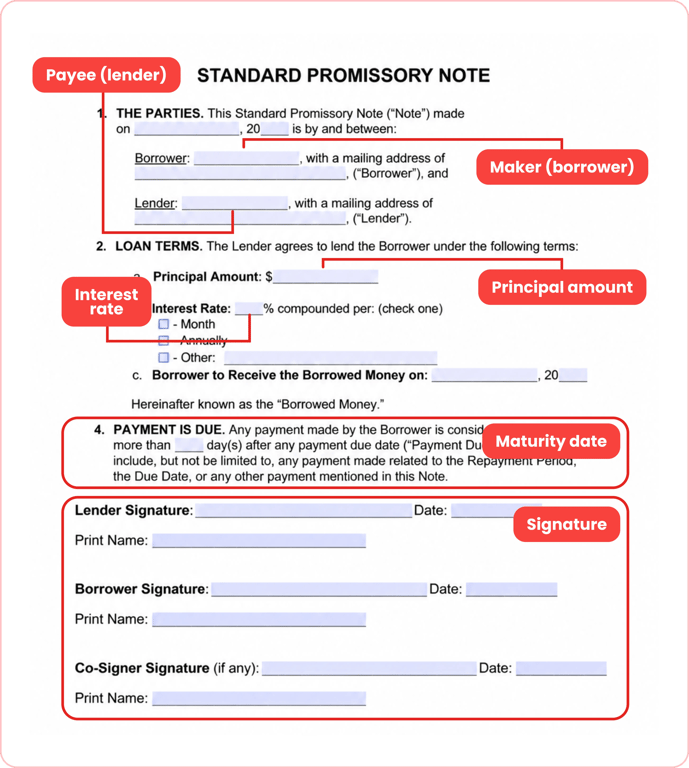
A promissory note is a written promise to repay the money you borrowed. The borrower (the maker) agrees to pay the lender (the payee) a specific amount. Payments can be made on a fixed date, in small increments, over time, or whenever the lender requires. By legal definition, this document makes the person obligated to return the money.
The main purpose of the note is to protect the sides during a loan. Its legal meaning goes far beyond a casual IOU because it gives the lender clear legal rights to collect the debt.
Key parts of a promissory note:
Written promise: States the amount of debt.
Identified parties: Names the borrower and the lender.
Clear terms: Outlines the interest rate, payment schedule, and due date.
Legal force: Becomes legally binding as soon as the borrower signs it.
Collateral options: Can be backed by property or left unsecured.
An allonge to a promissory note is a separate page attached directly to the original document. Lenders add an allonge when they run out of space on the main paper for new signatures or transfer notes.
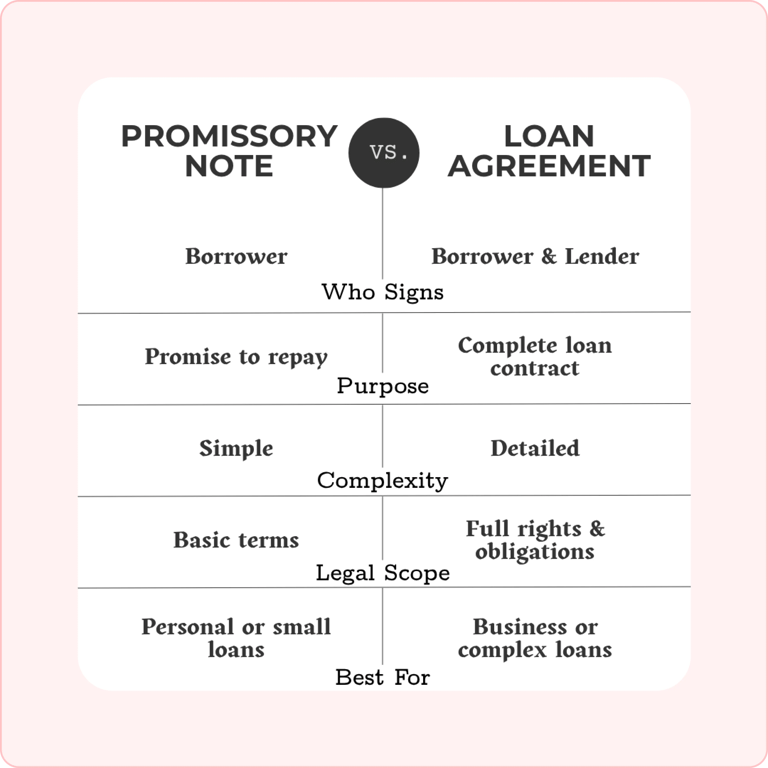
Promissory Note vs. Loan Agreement
Feature | Who Signs |
|---|---|
Promissory Note | Primarily signed by the borrower. |
Loan Agreement | Signed by the borrower and the lender. |
Feature | Complexity |
|---|---|
Promissory Note | Short and focused on repayment. |
Loan Agreement | Fully covered warranties, default rules, and covenants. |
Feature | Legal Status |
|---|---|
Promissory Note | A promise of payment. |
Loan Agreement | A complete bilateral contract. |
Feature | When to Use |
|---|---|
Promissory Note | For personal, family, or small business loans. |
Loan Agreement | For commercial loans, mortgages, and complicated transactions. |
Is a promissory note a contract?
Yes, it is legally binding as long as it meets standard rules. However, you should know what makes a promissory note invalid before lending any money. A note is no longer considered to be a legal document if the borrower does not sign it or if the loan amount is missing. A debt cannot be enforced if a due date is excluded or repayment terms are confusing.
Secured vs. Unsecured Promissory Note
A secured promissory note is backed by physical property, like a home, a vehicle, or a bank account. If the borrower stops paying, the lender can take that asset to cover the debt. A secured note is required for large loans or borrowers with bad credit.
An unsecured promissory note relies entirely on the borrower's promise to pay and their credit score. No physical property backs the loan. If the borrower defaults, the lender must sue to recover assets.
Lender Advantages | |
Secured Promissory Note | Fewer risks because the loan is secured by property. |
Unsecured Promissory Note | Fast and easy, and no need to inspect or appraise property. |
Lender Risks | |
Secured Promissory Note | If no payments are made, must go through the legal process to take the property. |
Unsecured Promissory Note | More risk of losing money if the borrower defaults. |
Borrower Advantages | |
Secured Promissory Note | Easier approvals, lower interest rates. |
Unsecured Promissory Note | Your property is not at risk. |
Borrower Risks | |
Secured Promissory Note | If you don’t pay, you can lose your property |
Unsecured Promissory Note | More difficult to get and usually has higher interest rates. |
Does a Promissory Note Need to Be Notarized?
Quick Answer: In most states, a promissory note is legal without a notary. But you are better protected with a notary if you end up in court.
A promissory note becomes legally binding the moment the borrower signs it. Getting it notarized is still a smart move because it proves who actually signed the paper. You must notarize the note if the loan is backed by real estate, like a mortgage. You can also sign the document digitally instead of using paper and ink. Federal and state laws generally recognize electronic signatures as legally valid, but some documents — including negotiable promissory notes — may be subject to additional legal requirements.
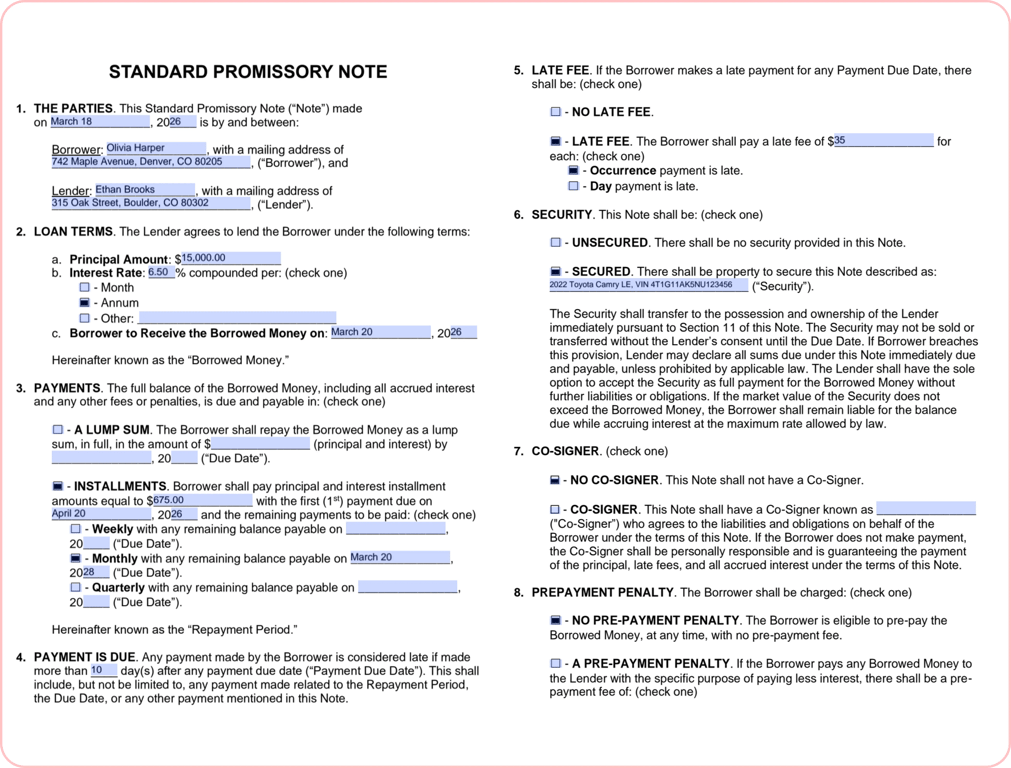
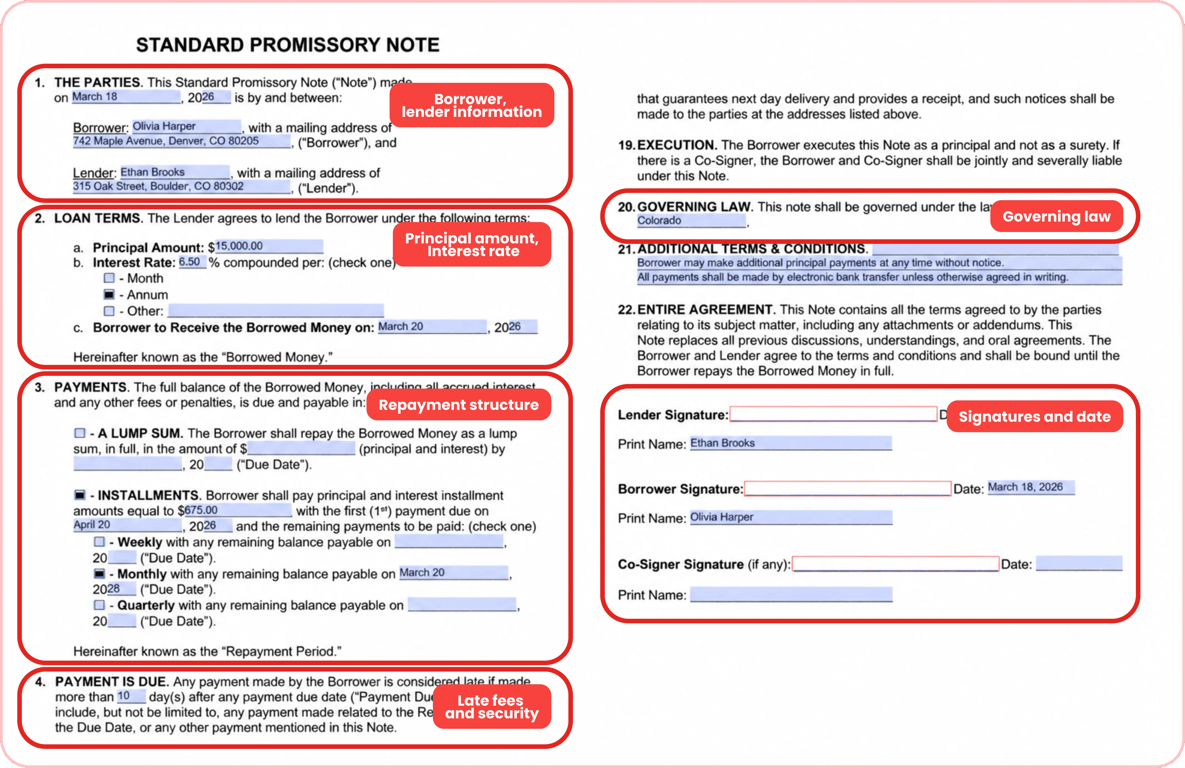
What does a Promissory Note look like
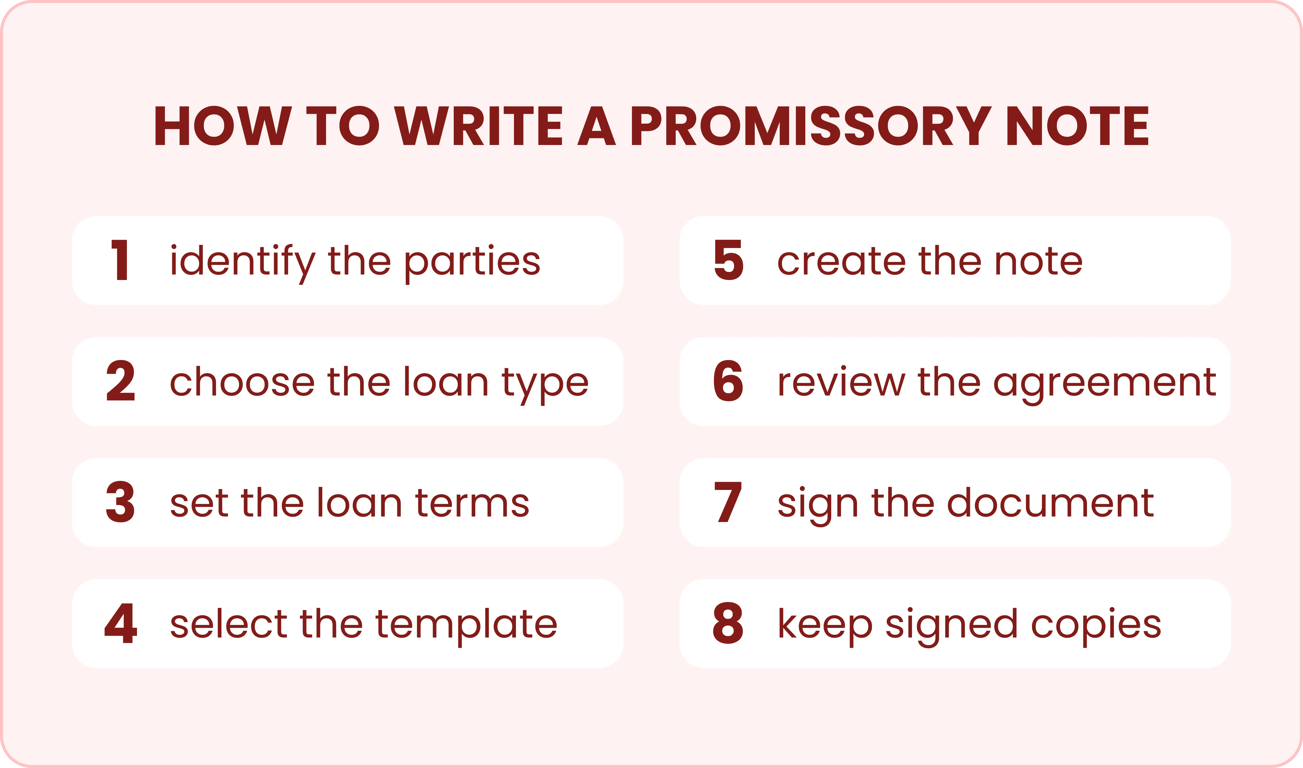
How to Write a Promissory Note
Identify the parties and loan purpose: Name who is lending the money and who is borrowing it. Identifying these roles in advance prevents rifts later.
Choose the right note structure: Select a secured or unsecured loan, and decide if you want to repay it over time or all at once. This will affect how much the borrower pays back and how protected the lender is.
Agree on the financial terms (loan amount, interest rate, repayment schedule, and late fees).
Select a promissory note format that matches your loan type and state regulations. A good template will help you make a sound agreement.
Draft the agreement: Use our online editor to create a promissory note.
Review the document: Both sides should double-check the text. Catching mistakes saves you time and money.
Sign and date the note: Sign the page with ink or use an e-signature. You can also have it notarized if the loan is secured by property.
Keep signed copies: The lender keeps the signed original paper, and the borrower gets a copy. This makes it easy to track the loan from signing to paying it off.
Required Elements of a Promissory Note
To build a legal promissory note, you must include a few core details. Missing any of these elements can make your contract invalid.
Date of execution: The date when the loan begins, and interest starts adding up.
Party information: Names and physical addresses of the borrower and the lender.
Principal loan amount: The total borrowed amount.
Interest rate: The annual interest percentage and how it is calculated.
Repayment schedule: The agreement states whether payments happen in regular installments, all at once in a lump sum, or on demand.
Maturity date: A deadline when the balance must be paid off.
Borrower signature: The borrower must sign to accept legal responsibility for repaying the debt.
Use a standard promissory note format to be sure your document covers all points.
How to Fill Out a Promissory Note
Learning how to draft a promissory note is simple when you fill out each section in order. Following a clean format keeps your agreement clear and legally sound.
Here is how to create a promissory note field by field:
Borrower, lender information: Write the names and physical mailing addresses.
Principal amount: Enter the total amount.
Interest rate: Enter the annual interest percentage and how often that interest accumulates.
Repayment structure: Choose whether the debt will be paid back in one lump sum or through regular payments over time.
Late fees and security: Add any grace periods. If the note is secured, describe the property used as collateral.
Governing law: Name the state whose laws will govern the contract.
Signatures and date: Have the borrower, lender, and any co-signers sign, print their names, and write down the date.
How to Make a Promissory Note Legally Binding
The loan agreement must meet these requirements to be valid in court.
Borrower's signature to accept legal responsibility for the debt.
Terms of the loan: amount, interest rate, and payment plan.
Execution date: Add the date when the agreement officially starts.
Legal capacity: Both sides should be legal adults and mentally able to sign a contract.
Independent witnesses: Non-biased witnesses who sign the page help you have additional evidence in case there is a dispute.
Notary seal: A notary stamp is a must for large loans or transactions in real estate.
Does a promissory note need to be notarized to stand up in court?
For most everyday loans, a notary is not strictly required. But their stamp proves that they actually signed the document and helps to ensure that the loan was not fraudulent. Independent witnesses offer similar protection by proving they saw the signing.
You can also choose to have the document signed electronically because digital signatures carry full legal power.
Promissory Note Payment Terms
While setting a payment schedule is helpful to both parties, this also affects promissory note interest rates. These terms include whether you will make payments in stages, one-time, or as a result of your lender's demand for payment on demand (also known as an earnest money promissory note).
Payment Method (Note) | Demand |
|---|---|
Description | The borrower makes repayment of the debt when the lender asks. |
Best Suited For | Personal or family loans with flexible timelines. |
Payment Method (Note) | Installment |
|---|---|
Description | The borrower makes equal regular payments of principal and interest. |
Best Suited For | Personal, auto, or small business loans. |
Payment Method (Note) | Lump-Sum |
|---|---|
Description | Borrower pays principal and interest in one payment on a fixed date. |
Best Suited For | Short-term loans or bridge financing. |
Payment Method (Note) | Balloon |
|---|---|
Description | Borrowers make small regular payments and then pay one large final installment. |
Best Suited For | Commercial real estate or seller financing. |
If a borrower wants to clear their debt early, they can request a payoff letter from the lender. This document states the final amount needed to close out the loan, including any remaining principal and daily interest.
Promissory Note Amortization Schedule
An amortization schedule is a simple chart that shows how each monthly payment splits between principal and interest. To calculate accrued interest, a note payable formula multiplies the remaining loan balance by the monthly interest rate. Over time, a larger portion of your monthly payment goes toward reducing the principal balance.
Month | 1 |
|---|---|
Monthly Payment | $608.44 |
Principal | $508.44 |
Interest | $100.00 |
Remaining Balance | $19,491.56 |
Month | 2 |
|---|---|
Monthly Payment | $608.44 |
Principal | $510.98 |
Interest | $97.46 |
Remaining Balance | $18,980.58 |
Month | 3 |
|---|---|
Monthly Payment | $608.44 |
Principal | $513.54 |
Interest | $94.90 |
Remaining Balance | $18,467.04 |
Month | 4 |
|---|---|
Monthly Payment | $608.44 |
Principal | $516.10 |
Interest | $92.34 |
Remaining Balance | $17,950.94 |
Month | 5 |
|---|---|
Monthly Payment | $608.44 |
Principal | $518.69 |
Interest | $89.75 |
Remaining Balance | $17,432.25 |
Month | 6 |
|---|---|
Monthly Payment | $608.44 |
Principal | $521.28 |
Interest | $87.16 |
Remaining Balance | $16,910.97 |
Principal: $20,000.00
Interest Rate: 6.00% APR
Term: 36 Months
Total Interest Paid: $1,903.84
Promissory Note Payoff Letter
A payoff letter is an official statement from the lender that shows the amount needed to pay off a loan by a specific date. It is different from a release of a promissory note, which the lender gives you only after receiving payment to cancel the debt. Borrowers usually ask for this letter when refinancing, selling attached property, or paying off their balance early.
Statement date: The issue date and deadline for the payoff.
Original note reference: Details linking back to the initial contract (the execution date, original loan amount).
Payoff amount: The total sum with remaining principal, accrued interest, and processing fees.
Lender's signature to confirm the payoff terms.
Modifying, Extending, and Transferring a Promissory Note
You can modify, extend, or transfer a loan agreement at any time during the loan. However, you must put all changes in writing. If you do not record the adjustments in an official document, the new terms will not hold up legally.
Amendment to a Promissory Note
An amendment to a promissory note is a short written document that changes specific terms. For example, it can update your interest rate, payment schedule, or final due date. Both the borrower and the lender must sign this paper and link it directly to the original contract.
If you are making several major changes at once, you can create an amended and restated version instead. This replaces the old contract entirely with one single, updated document.
Extension of a Promissory Note
A renewal and extension of a promissory note gives the borrower extra time to repay the debt. Signing a renewal and extension of a promissory note helps prevent a default when a borrower needs more time to catch up. Interest usually keeps adding up under the original terms during this extra period. Without a signed extension, the lender keeps the legal right to demand full payment as soon as the original due date passes.
Assignment of a Promissory Note
An assignment happens when the lender sells or transfers their right to collect payments to a new person or company. When a formal transfer of promissory note takes place, the lender must send the borrower a written notice with the new payment details.
If the note is a negotiable instrument under commercial law, the lender can transfer it without the borrower’s permission. This transfer changes who gets paid, but not the borrower's debt obligation.
Get the most current Official Standard Promissory Note for Loan Agreement and Terms form now
Up-to-date • Fillable • Ready to sign online