Get the most current Transfer on Death (TOD) Deed form now and subscribe to download
A transfer on death deed form is a standardized template that real property owners can obtain and fill out to prepare a legally sound transfer on death (TOD) deed document.
Our platform offers you a comprehensive TOD kit, inside which you will find a set of clear instructions that explain what a transfer on death deed is and how to implement it, a printable form of a TOD deed, a cancellation of transfer on death deed form, and an affidavit of death form for re-titling the property after the owner’s death. Get our complete TOD kit now and fill out your TOD deed right from the browser, without installing additional software.
What is a transfer on death (TOD) deed?
A transfer on death (TOD) deed is a legal document that allows a property owner to name a primary and secondary beneficiary (or multiple beneficiaries) who will inherit a specific real property unit after the owner’s death.
Although it sounds similar to a standard will, the main distinctive feature of a TOD deed is that it speeds up the inheritance process by bypassing lengthy probate courts. Also, unlike a will, it doesn’t handle all assets of a deceased person – only specific real estate.
Unlike a regular deed that immediately executes the transfer of property, a TOD deed comes into full effect only after the death of the owner. When this happens, the beneficiary must file an affidavit of death and re-title the property indicated in the deed in their name. During the owner’s lifetime, they retain full control over the property.
The following sections explain the TOD deed in detail and provide instructions on how to complete it. Bear in mind, this content is not legal advice.
TOD deed vs. beneficiary deed (synonyms)
A transfer on death (TOD) deed (or TODD) goes by different names, depending on the state. Other than that, a transfer on death deed, TODD, and a beneficiary deed refer to documents used for the same nonprobate transfer purpose.
Term Used | Beneficiary deed |
|---|---|
States |
|
Term Used | Transfer on death deed/TOD deed/TODD |
|---|---|
States |
|
Can you revoke a TOD deed? (revocable deeds)
Since the owner retains full control of the property during their lifetime, they have the power to revoke or change a TOD deed at any time. There are three ways to do it:
Creating a new TOD deed lets you change the assigned beneficiaries.
Filing a revocation/cancellation of transfer on death deed form at the local County Recorder’s Office lets you cancel the deed in the public record. You can find a cancellation form in our TOD deed kit.
Selling the property indicated in a TOD deed automatically cancels it because the property gets re-titled in the name of a new owner. This is one of the primary differences of this document in contrast to another similar agreement, a life estate deed. This agreement lets the owner live in the property until they pass away, but instantly transfers legal future interest to the assigned heir. This way, it eliminates the possibility of selling the property without the permission of the beneficiary.
What a transfer on death deed form includes
A standard transfer of deed on death consists of 8 essential elements:
Property owner(s): Full name of the primary property owner and the second owner (for example, a spouse) who is making the deed.
Legal description of the property: A formal description (not a mailing address) of the property’s location, boundaries, and dimensions.
Address of the property: Physical address with an indication of a county.
Primary and alternate beneficiaries: Full names and mailing addresses of all primary and alternate beneficiaries you want to include in the deed.
Transfer on death: A formal statement of the owner to convey the property to the primary or alternate beneficiaries after their death.
Signature of property owner(s): A formal space where the owner(s) of the property must place their signature, usually in “wet ink” and in front of a notary public.
Notary acknowledgment: A standalone field that should be filled out exclusively by a notary to confirm the deed was acknowledged before them. This field typically includes the state, county, date, the owner’s name, and the name and signature of a notary public.
After recording, please return to: Additional field with the owner’s name and mailing address. It’s used so that the county’s clerk knows where to mail the original deed after it has been recorded with the county.
How to fill out a transfer on death deed
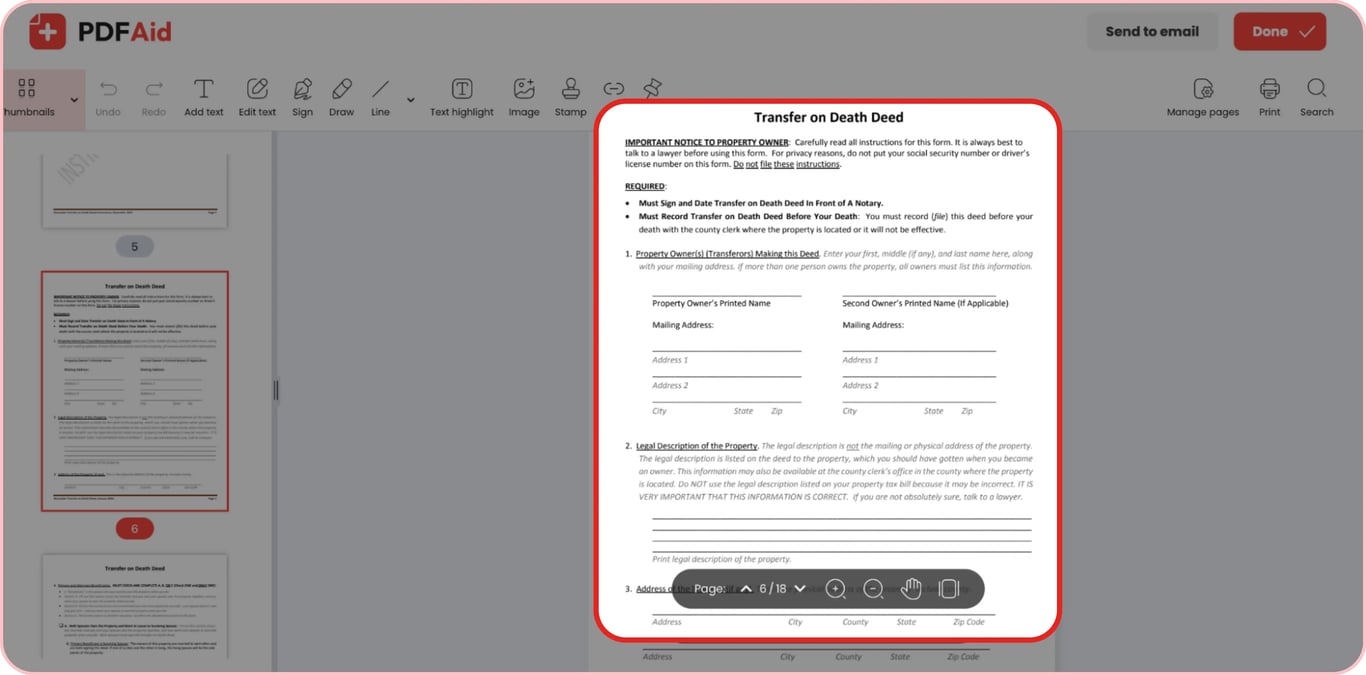
If your estate situation is fairly simple and you don’t need legal help to draft the document, you can use our printable template to create a transfer-on-death deed. Here’s how to do it step by step:
Step 1. Click Get Form on the Transfer on Death Deed Kit page on our platform to open the template.
Step 2. Carefully read the first pages with instructions before completing the form.
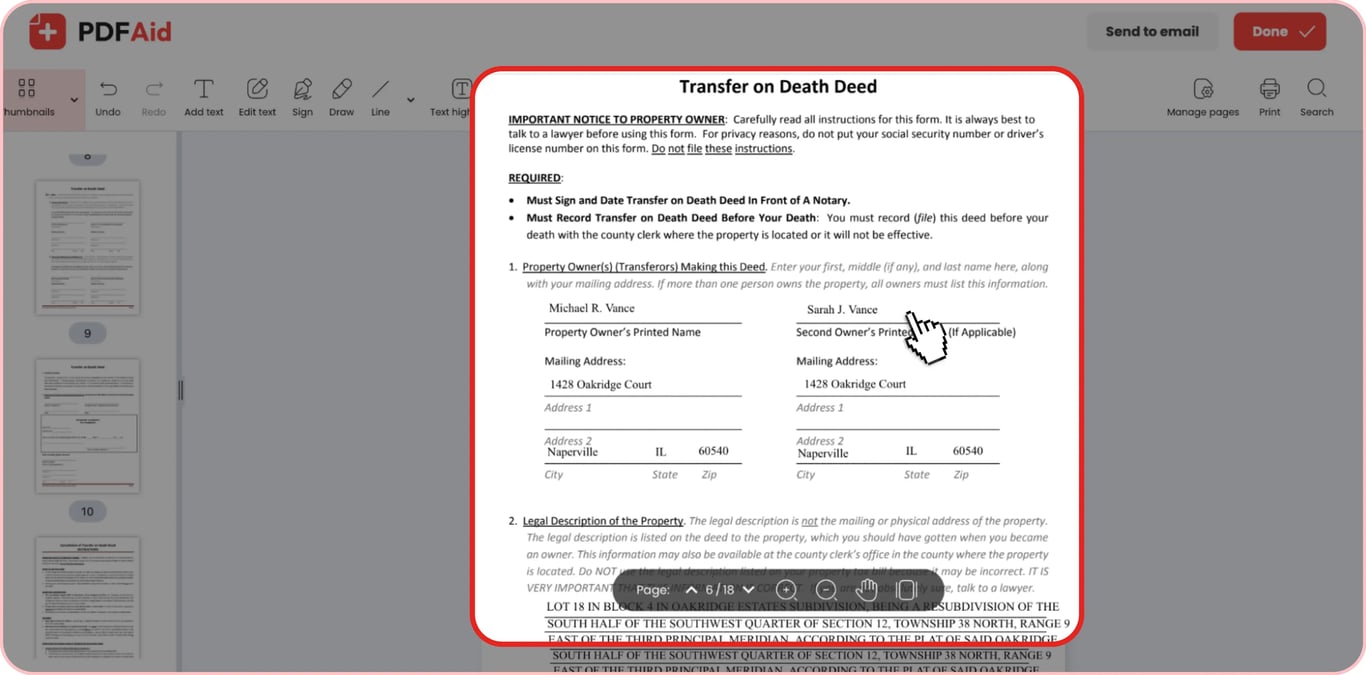
Step 3. Fill in your full legal name and mailing address in the Property Owner section. Include the name and address of the second owner (if applicable).
Step 4. Provide a comprehensive legal description of the property. Be sure to include details like lot, block, metes and bounds, and government survey system/rectangular survey.
Step 5. Indicate the physical address of the property.
Step 6. Complete the Primary and Alternate Beneficiaries section. First, check a section option that suits your situation: A) you’re married, and both spouses own the property specified in the deed, B) you’re married but are the only owner of the property, or C) other. After choosing, complete the relevant section by providing full legal names and mailing addresses of the primary and alternate beneficiaries. If your spouse co-owns the property, check how the property is titled and how your state’s survivorship rules affect the TOD deed before naming beneficiaries.
Step 7. Check the entire document for errors. Then, click Done in our editor and export the completed sample as a PDF.
How to sign and record a TOD deed
A transfer on death deed cannot come into legal force until it’s notarized and recorded with the local county. This is important to prevent fraud and minimize the likelihood of the deed being contested – a notary public acts as proof of the owner’s identity and mental capacity at the moment of signing, and a record with the county creates a public record mandatory for real estate transfer after the owner’s death.
Notarizing and signing the deed
After completing the TOD deed, you must sign it. All US states also require notarization for such documents. The requirements vary by state and county recorder — some still require in-person wet-ink signing, though most states now permit remote online notarization. Some states, such as California, New York, and Illinois, also mandate two witnesses to sign the deed in front of a notary public.
Here’s how to sign your deed step by step:
Download the form you filled out using our platform and print it.
Check the current laws of your state to double-check whether you need to invite witnesses or not.
Make an appointment with a notary.
Arrive at the notary’s office with your deed and witnesses (if required) and sign the document.
Recording with the county recorder
A signed deed must be legally recorded with a local county recorder during the owner’s lifetime. This is a mandatory step. Skipping it will leave your deed without legal effect.
Here’s a simple checklist to help you through this process:
Prepare your deed. Check the local recorder’s requirements for document formatting, copies, identification, submission methods, and any additional filing documents. Additional document prep tips for filing with a county recorder:
Ensure the deed includes a complete, formal description of the property.
Leave 2.5- to 3-inch margins for the recorder’s stamp.
Prepare an original and one copy of your TOD deed for filing.
If you are using our form to create a deed, do not file the pages with instructions (1-5).
Find a County Recorder or Register of Deeds office located in the same county as the address of your real estate. Check the official websites of your county or state directories to find the address of the office.
Bring additional documents that a county clerk may require. In most cases, you will definitely need personal identification documents. Depending on the state, you might also need additional documents.
Pay the recording fee in your county clerk’s office. Check the fee applicable in your county on the official website before you arrive at the County Recorder, because fees can vary drastically. For example, Kent County (Delaware) applies a fee of $88 for the first 5 pages plus $10 for each additional page.
Get the most current Transfer on Death Deed Kit for Efficient Estate Planning form now
Up-to-date • Fillable • Ready to sign online