Get the most current Release of Liability Form and subscribe to download
A general release of liability form is a legal agreement in which one party, the releasor, waives specified rights to sue or bring claims against another, the releasee. It’s essentially a way to resolve potential disputes after an incident, protect businesses and organizers before high-risk activities, or put the final touch on property or business deals.
With PDFAid, you can fill in a release of liability template online, e-sign it, and download a finished PDF. All in your browser, without installing anything extra.
Disclaimer: This information is provided for general purposes only and does not serve as legal advice. When dealing with documents that have significant legal or financial implications, consult a licensed attorney in the applicable jurisdiction.
What Is a General Release of Liability Form?
A general release of liability form is a written agreement in which one person or organization agrees not to hold another person or organization legally responsible for specific injuries, losses, or damages.
In legal documents, it's also often referred to as a release of liability waiver form, a liability waiver, a waiver of liability, and may be combined with a hold harmless agreement.
Under the general release definition, once signed and enforceable, it typically prevents the releasor from bringing a future lawsuit over the covered events.
When are such forms typically used? A release of liability form is used whenever an activity involves risk, providing written proof that the other party has agreed not to pursue a lawsuit. This includes but is not limited to gyms, property rentals, schools, events, or freelance work. So if you're joining a sports team, renting gear, working with a personal trainer, or resolving a property issue, there's a chance you'll encounter one.
Who signs a release of liability form? There are two sides:
Releasor, the party giving up the right to claim
Releasee, the one being protected from liability
Is a release of liability form legally enforceable? Yes, but enforceability varies by state. So it's worth getting a legal review before relying on a release for anything with significant stakes.
Release of Liability vs. Insurance vs. Indemnification Clause
These three terms all relate to risk, but they are not interchangeable and handle it in different ways:
Release of liability extinguishes a claim outright. Once signed, the releasor gives up the right to sue over whatever the form covers.
Insurance is a paid policy that covers the cost if something goes wrong. It doesn't prevent a claim from being made. It just provides the money to pay for it.
An indemnification clause determines who is financially responsible for specified losses or claims, including certain claims brought by third parties. It doesn't erase liability either, just decides who covers the cost.
Types of Release of Liability Forms
There are different types of general release forms depending on the activity, the relationship between the releasor and releasee, and the jurisdiction. The four common types are:
Activity and event. These are waivers for recreational activities, sports leagues, camps, and entertainment venues.
Personal service. These are forms between clients and trainers, therapists, photographers, or beauty professionals.
Property and rental. These are waivers for renting equipment, space, or property.
Travel and outdoor. These are forms for activities such as tours, horse riding, field trips, and employee travel.
Often, a simple release of liability form, a single page covering one event or service, is enough. It works for low-risk, one-off situations. However, there are also state-specific waivers that are stricter and vary by state. For instance, California generally doesn't enforce liability waivers that attempt to release future gross negligence in sports or recreational programs or services (City of Santa Barbara v. Superior Court, 41 Cal. 4th 747 (2007)).
Also, when the risk is specifically health-related, a special medical liability waiver form should be used. For any physical activity where bodily harm is the main concern, an injury waiver form is commonly used.
Activity and Event Liability Waiver
Activity and event waivers are used by venues and organizers when participants take on physical risk as part of a recreational activity, sport, or event. As a rule, such waivers are signed before the activity begins and cover injuries, accidents, or incidents that might occur.
Trampoline liability waiver (such as Sky Zone waiver form or Urban Air waiver form): covers falls, collisions, and overexertion
Shooting range waiver: signed before handling firearms, covering equipment misuse and accidents
Swimming pool liability waiver: used by private clubs, community pools, or swim schools
Sports waiver: covers recreational leagues, contact sports, and team competitions
Camp liability waiver: used by summer camps and outdoor programs
Activity waiver: a general-purpose format that fits almost any organized event
Tattoo waiver form: signed before a tattoo procedure and acknowledging specified risks, such as reactions or infection
Personal Service Liability Waiver
Personal service waivers apply when a client works one-on-one with a service provider, such as a trainer, photographer, massage therapist, or stylist. The form defines what each party is responsible for, which matters if a client is injured (or affected by any indicated risk) during a session or disputes the result.
Personal training liability waiver: covers injuries during exercise and clients' pre-existing conditions
Gym waiver: required before using equipment at gyms
Fitness waiver: covers group classes, boot camps, and coached programs
Massage waiver: covers pressure injuries and reactions to oils or products during massages
Hair salon waiver: signed before chemical treatments where scalp reactions are a risk
Photo waiver: gives permission to use photographs and also addresses potential claims related to the session
Property and Rental Liability Waiver
Property and rental waivers are used whenever someone rents property, equipment, or a venue. Such waivers shift responsibility for potential damage or injury from the owner to the renter and range from a simple one-page agreement to a multi-clause document, depending on what's at stake.
Equipment rental waiver: covers tools, machinery, vehicles, and party equipment
Bounce house waiver: covers injuries to children using inflatable rental equipment
Haunted house waiver: used by haunted attractions to cover injuries from scares, falls, or physical contact
Vehicle damage waiver: outlines responsibility or available damage-waiver coverage if a rented vehicle is damaged
Property damage waiver: defines what counts as tenant-caused damage to a rented property
Tenant waiver: limit certain injury claims against landlords, subject to applicable landlord-tenant law
Waiver of liability for injury: covers general property-related harm
Travel and Outdoor Liability Waiver
Travel and outdoor waivers tend to be more detailed than standard activity waivers. This is because once people leave the property and head into unpredictable terrain, there's less control over what can happen. That's why such waiver forms need to name the specific risks of the environment rather than the activity only.
Horse riding waiver: acknowledges risks such as falls, kicks, and unpredictable horse behavior
Equine waiver: used by stables and equestrian facilities for a broader range of equine-related risks
Motorcycle ride waiver: used for moto group rides, tours, or club events
Field trip waiver: often requested by schools before students leave campus
Employee travel waiver: covers personal injury and liability for staff traveling on company time
How to Write a Waiver Form
To create a waiver form (or release of liability contract) that works, it should contain the important parts.
Names and identifying details of both parties. Legal names for individuals, registered names and addresses for businesses. It has to be clear who the releasor and the releasee are.
Date and location. When the agreement takes effect, and where the activity or service takes place.
Description of the activity or incident. This explains what the release actually covers: the specific risks, services, or events involved. The more precise this is, the harder the document is to challenge in court.
Consideration. This is about what the releasor receives in exchange for signing, for instance, access to an activity, a payment, or a service. A release of all claims form with no consideration can be invalidated.
Governing law. This specifies which state laws will be used to interpret your liability waiver in case a legal dispute occurs.
Assumption of risk clause. A line stating the releasor understood the risks and agreed to them voluntarily.
Signatures and date. The required parties sign, with a date next to each. For minors, a parent or guardian signs instead.
A few more considerations:
Scope of the release. A waiver should specify it. A general release of all claims covers all existing and potential claims arising from the described context. A narrower release covers only specific incidents or injury types. Choose based on your situation.
General release language. Use precise language for your waiver to be legally effective. A typical general release of claims clause looks like this: "Releasor hereby releases, waives, discharges, and relinquishes any and all claims, demands, or causes of action against Releasee arising from [described activity or event]."
Mutual release vs. one-sided release. You should indicate what kind of release it is. A mutual release goes both ways, meaning each side releases the other, which is typical in business settlements. A one-sided release only protects one party.
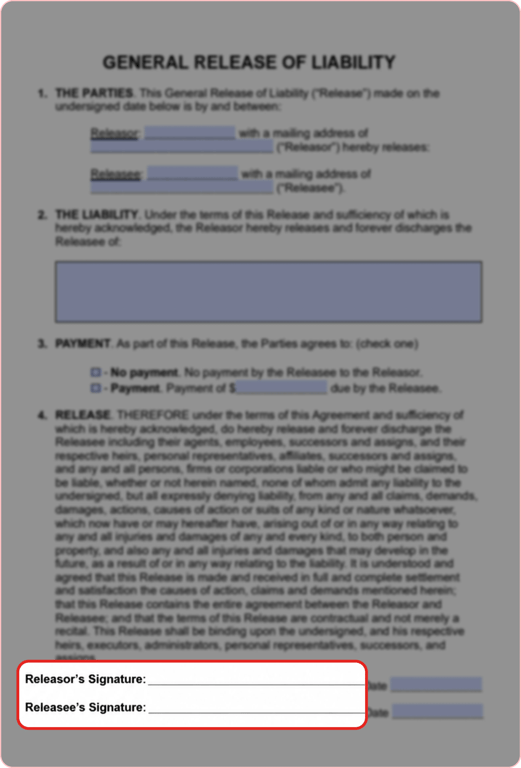
Here's a ready-to-fill-in PDFAid liability waiver template you can use.
How to Fill Out a General Release of Liability Form
The entire process happens in your browser with PDFAid, no downloads required to get started.
Step 1. Open the template. Click "Get form" on this page, and the online waiver form opens directly in the PDFAid editor.
Step 2. Enter party details. Fill in the names and addresses of both the releasor and the releasee.
Step 3. Describe the liability. In the liability field, describe what the releasor is releasing the releasee from (the incident, dispute, or activity the release covers).
Step 4. Select the payment option. Check whether the release involves no payment, or specify the payment amount due from the releasee to the releasor as part of the agreement.
Step 5. Review the release clause. The release language is pre-written and covers all claims, damages, and causes of action. Read it through to confirm it fits your situation.
Step 6. Add signatures. Both the releasor and releasee sign and date the form. You can sign electronically via the connected service.
Step 7. Download or share. Export it as a printable release of liability form. Send it by email, or print it if either party prefers to sign on paper.
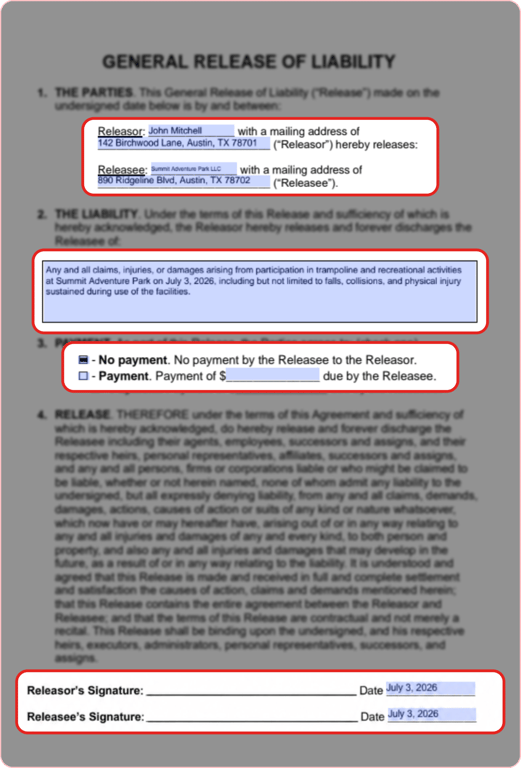
Here's a liability waiver example to understand what a completed form looks like.
How to Sign a Release of Liability Form Online
You can e-sign an electronic waiver form right on PDFAid. Here's how:
Open the form in PDFAid and click the signature field.
Sign the form via the connected service.
Done. Now you can download the form. The same signature can be reused across multiple documents in the same session.
Is an electronic waiver sign legally valid? In the U.S., yes. The ESIGN Act (2000) makes e-signatures legally binding for most commercial and personal documents, provided both parties consent to signing electronically. Standard liability waivers almost always qualify. Outside the U.S., the rules might differ. So, if your digital waiver needs to be enforceable in a specific country, verify local requirements or consult a lawyer.
Get the most current General Release of Liability Document - Waive Future Claims Agreement form now
Up-to-date • Fillable • Ready to sign online