Get the most current Marital Settlement Agreement form and subscribe to download
A marital settlement agreement (MSA) is a legally binding contract signed in the process of divorce.
On our platform, you will find an up-to-date marital settlement agreement form that you can fill in and sign online, right from your browser.
What Is a Marital Settlement Agreement?
A marital settlement agreement, also known as a divorce settlement agreement, is a formal document signed by spouses in the process of divorce or legal separation. In a mutual and uncontested divorce, a DIY settlement agreement can help ex-spouses resolve questions related to property, child custody, spousal support, and other issues without spending additional time and money on costly legal proceedings. Yet, this document must cover every relevant term and be legally sound to prevent future disputes and unwanted expenses.
An MSA is typically created right before or shortly after a couple initiates a divorce/separation case in court: the divorcing spouses negotiate the terms, agree on contract provisions, and sign a completed document. Then, the document is submitted to the court for the approval of the judge. After approval and all divorce proceedings, an MSA becomes a part of the divorce decree, and its terms turn into a mandatory, enforceable court order.
This contract is not strictly mandatory in all states, especially if there is no marital property, joint debt, or mutual minor children. However, it’s often recommended to sign an MSA to prevent the court from making decisions on alimony, asset division, and child custody for you.
Other Names for the MSA (Property / Divorce Settlement Agreement)
A marital settlement agreement goes by several different names:
Property settlement agreement: Historically, this term was used to describe contracts that cover how divorcing spouses will divide their assets and debts. Today, a property settlement agreement is just another name for an MSA because its clauses can cover all aspects of a divorce, not just the financial side.
Divorce settlement agreement: A common, plain-English term that defines the final divorce contract that contains the terms under which a couple will separate.
Marital dissolution agreement: The formal term used in jurisdictions that call the process of divorce a dissolution of marriage. States that often use this term include Ohio (applies to mutual divorces), Minnesota, Washington, and California.
Divorce contract: A casual term typically used by the public to describe a legally binding contract signed in the process of a divorce.
Although they go by different names, these documents have the same nature and purpose.
The MSA in an Uncontested or Mutual Divorce
An MSA is particularly helpful when it acts as a mutual divorce agreement. In uncontested/mutual divorce cases, this document provides the following benefits:
Time-efficiency: If divorcing spouses can mutually decide on the terms of their divorce, an MSA eliminates the need for lengthy trials.
Money savings: When the parties voluntarily sign an uncontested divorce agreement template, they can significantly reduce court-related costs and legal fees.
Greater control: Litigations that proceed without an MSA leave judges with the right to settle different aspects of a divorce at their discretion, leaving spouses with less control over how they divide assets and custody.
Faster judicial approval: Judges often approve MSAs written according to state laws and child-support guidelines faster, which also reduces the time in court.
What a Marital Settlement Agreement Includes
A standard MSA consists of 12 main sections:
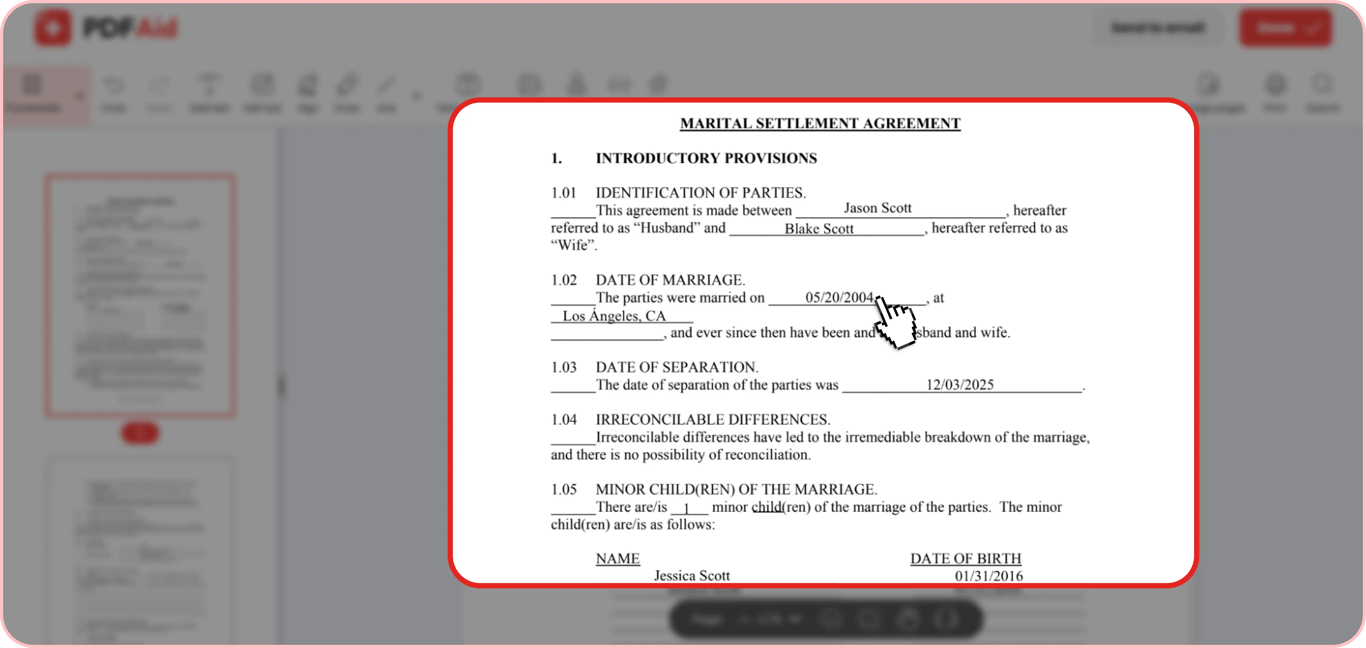
Introductory provisions: Includes the identification of parties, dates of marriage and separation, statement of irreconcilable differences, information on minor children, purpose of agreement, and waiver of final declarations of disclosure.
Custody and visitation: Provides a detailed explanation of the agreed child custody and visitation terms.
Child support: Clarifies the details on child support payments.
Spousal support: Clarifies the details on spousal support payments.
Property: Provides a list of community and separate property owned by divorcing spouses and states the division terms.
The family residence: Defines what happens to the marital home after divorce.
Retirement benefits: Clarifies how divorcing spouses will divide retirement benefits.
Other property provision: Details the terms for allocating income tax refunds, handling the assets acquired after separation, and other non-standard property division cases.
Other general provisions: Lists additional terms of the agreement.
Property warranties and remedies: Provides formal warranties that all debts and assets have been completely disclosed at the moment of making an agreement.
General provisions: Communicates the general terms of the agreement, such as those concerning the release of liabilities, waiver of rights on an ex-spouse’s death, notice of bankruptcy filing, the status of the current agreement in the event of reconciliation, acknowledgments, and others.
Signatures and dates: The formal space where divorcing spouses need to date and sign the agreement.
General provisions often remain standard in MSAs. However, sections that cover asset/debt division, custody, and support require an individual approach.
Dividing Property, Debts & the Family Home
The Property section of a standard MSA begins with the identification of the separate and community property owned by both spouses:
Separate property includes assets owned before marriage or received in the form of gifts or inheritances. MSAs usually include a waiver-of-rights statement (the other party disclaims all rights and interest) in relation to separate property of both spouses.
Community property is a list of assets and liabilities assigned to each spouse as their shares in mutually acquired property and debt. How you can divide your property depends on the state. 9 states, including Arizona, California, Idaho, Louisiana, Nevada, and others, have mandatory community property laws that imply a 50/50 division. Other states typically use the “equitable distribution” principle when dividing assets and debt. Equitable distribution aims to divide property between spouses fairly, but this doesn’t necessarily mean 50/50.
In the case that one spouse’s share of community property is unequal, MSAs often include a Payment to Balance Division clause that requires one party to pay a specific amount of money before the agreed-upon term to equal property division.
The division of the family residence (if it’s not separate property of one of the spouses) also falls under the 50/50 division or equitable distribution principle, depending on the state. Often, this matter is settled in one of the following ways:
Sale: Selling a house and dividing its remaining cost after all fees and mortgage (if any).
Deferred sale: Postponing the sale for an agreed time (often because of having a minor child) and dividing the cost later. Before the house goes to the market, one of the spouses and a child typically continue living in the family home.
Trade-off: Assigning the family residence to one of the spouses under the condition that the other one receives an equivalent share of other assets.
Divorce buyout: Assigning the family residence to one of the spouses under the condition that they buy out the other spouse’s share of the house. If there is a mortgage, this process typically requires refinancing it into the name of the person who keeps the home.
If divorcing spouses used to have a mutual account(s) in a bank, an MSA should also detail how they are going to split a joint account. The process usually involves opening personal accounts in each spouse’s name and dividing shared funds by transferring them to new accounts.
Child Custody & Support Provisions
When a couple with children gets a divorce, child custody and support become important provisions of an MSA. The spouses must agree on who will hold legal custody (the right to make major life decisions for the child) and physical custody (physical residence with the child). Both types of custody can be sole or joint, and all these details must be stated in the settlement agreement.
Another crucial clause in the divorce custody agreement is the parenting time and visitation schedule. In this clause, the couple writes down when and how each spouse will spend time with the child.
Finally, an MSA should spell out the agreed-upon child support terms in full. The divorcing spouses must file a child support order in their dissolution case or initiate the Department of Child Support Services action case and provide the case number in their agreement. Further, in the MSA, they must provide detailed payment provisions: who pays to whom, the sum, the monthly payment deadline, and how the money is allocated if there is more than one child. An MSA should also cover how spouses will handle health insurance and uncovered health care expenses after their divorce.
How to Fill Out a Marital Settlement Agreement on PDFAid
If you are drafting a mutual marital settlement agreement, our printable template and PDF editor offer you a fast and convenient way to create your document and sign it. Here is how.
Step-by-Step: Completing the Form
Follow these steps to fill out our marital settlement agreement template:
Step 1. Go to a Marital Settlement Agreement form page on PDFAid and click “Get Form.” Our PDF editor will instantly open a divorce agreement template ready to fill out.
Step 2. Complete the Introductory Provisions section. Fill in the full legal names of both spouses, date and place of marriage, date of separation, and information about any children who are under age at the moment of divorce.
Step 3. Fill out the Custody and Visitation section based on the terms that you both agree on. Indicate a relevant case number, assign physical and legal custody, write the rules for parenting time and visitation, and indicate child support provisions.
Step 4. Complete the Spousal Support section if applicable.
Step 5. Fill in the Property section. Provide a detailed list of the husband’s and wife’s separate property, then list community property assigned to each spouse, and include the details of the payment to balance division if necessary.
Step 6. Detail the terms for dividing the family residence. Specify the occupancy terms, maintenance liability, and other information according to your agreement.
Step 7. Draft other property and general provisions that you wish to include in your MSA.
Step 8. Remember that the provided template is a standardized sample, and carefully go through all its provisions to ensure that it suits your situation. If there are any provisions that you’d like to remove or change, click the Edit Text tool in our editor and make the needed amendments.
Step 9. Click Done in the upper right corner of our editor, name your file, and pick the preferred format to export a copy of a filled-in MSA. Or move on to signing.
Signing & Notarizing Your MSA
When your MSA document is ready and checked, you can sign it right away using our editor. Follow these simple steps:
Step 1. Open a filled-in MSA and scroll to the bottom of the form.
Step 2. Type the date of signing.
Step 3. Type your name.
Step 4. Click on the Sign tool and draw, upload, or type your signature.
Step 5. Resize the signature and place it in a dedicated place.
Check before signing: Whether MSAs need to be notarized during signing or not depends on the state. Some states, including North Carolina and New York, mandate MSA notarization. In some states, particularly in Ohio, MSAs can be either notarized or signed before two witnesses. Check your local jurisdiction’s laws to double-check formal requirements. If required, print the filled-in form and sign it in front of a notary public to get a notarized divorce agreement.
Get the most current Marital Settlement Agreement - Divorce Terms and Child Custody Provisions form now
Up-to-date • Fillable • Ready to sign online