Get the most current Texas Residential Lease Agreement Form and subscribe to download
A lease contract is a formal agreement between a landlord and a tenant that sets the terms for leasing real estate and defines the rights and obligations of the parties involved.
On our platform, you can find a fillable Texas Lease Agreement form (or upload your own template), fill it in, sign it, and export the completed version in a variety of formats, including PDF, Word, and others – all directly from your browser.
What Is a Texas Lease Agreement?
A Texas rental agreement is a contract signed for the lease of property and governed by Texas law. A standard residential agreement is a contract for renting a residential property, such as an apartment, house, or condo.
Depending on the property type, the lease agreement can be residential or commercial. Its type, as well as the jurisdiction under which it’s governed, directly affect the contents, structure, contract duration, notice periods, and limitations.
Texas landlord-tenant laws are often considered landlord-friendly, although they still impose specific duties and restrictions on landlords. The Texas Property Code establishes rights, duties, and procedures regarding security deposits, evictions, repairs, and other lease-related processes. So, when you need to build a Texas residential lease agreement or, even more so, a commercial agreement, it’s important to make sure it reflects the applicable Texas requirements.
Key facts to know about residential agreements in Texas:
The parties to the agreement are a landlord who provides the residential property and a tenant who will rent it.
The common contract duration is 12 months.
A standard agreement contains data about the cost of the rent, the amount of the security deposit, and the living rules.
Key Sections of a Texas Rental Agreement
A typical Texas residential lease agreement form commonly includes 8 core sections:
Parties: Explicitly states full legal names of the landlord and tenant, their mailing addresses, and phone numbers. If more than one person is planning to live in the property, the names of all additional occupants (including minors) are also listed.
Property: Provides a full address and description of the rented residential real estate.
Lease Term: Specifies the start date of the lease and the contract validity duration.
Rent: Precisely outlines the full sum of the rent, due date, grace period, and a fee that applies when a tenant misses due dates (late fee).
Security Deposit: Outlines the amount of a security deposit received by the landlord and refund terms.
Rules: Provides a detailed explanation of property-specific rules. This can include policies on occupancy, guests, quiet hours, smoking, pets, subletting, etc.
Maintenance: Communicates the landlord’s requirements and expectations for cleanliness and the tenant’s maintenance responsibilities without waiving the landlord’s statutory repair duties. This usually includes keeping real estate in sanitary condition, performing proper trash disposal, and handling repairs according to agreed terms. This section also specifies who is responsible for different types of repairs.
Signatures: The formal space where a landlord and tenant must put their signatures, print their names, and the date of contract signing.
How to Fill Out a Texas Lease Agreement Online
Our platform gives you a fillable rental agreement form for Texas. To create an agreement, follow these simple steps:
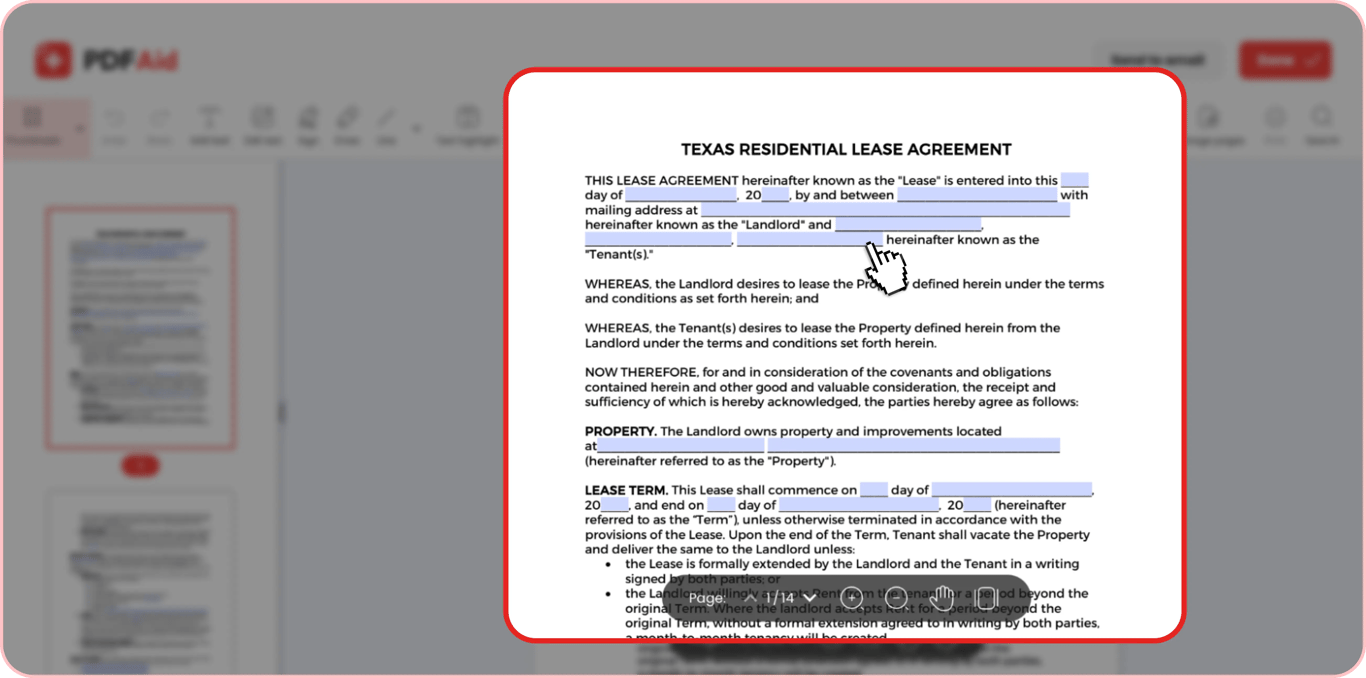
Step 1: On this page, click “Get form” to be redirected to our PDF editor, where the template is already open.
Step 2: Fill in the empty fields. Inside the form, all fields that must be filled in manually are highlighted in blue. Begin completing the document by typing the date of the agreement and the parties’ data at the top of the page. Then, provide the address of the property and its description. Fill in all the other parts of the document step by step:
Lease term
Rent
Security deposit
Return
Use of property
Assignment
Right of entry
Non-delivery of possession
Utilities
Pets policy
Default
Emergency phone number
Notice
Parking
Early termination
Smoking policy
Step 3: Review the completed document and all its provisions to detect and fix typos and errors.
Step 4: Sign the agreement.
Step 5: Click “Done” in the upper-right corner, name the file, and download it in your preferred format, for example, PDF, DOC, or DOCX. Share the file with the second party of the agreement – you can attach the downloaded file to an email manually or send the file to the recipient’s email directly from our editor.
Also, remember that PDFAid provides you with a printable rental lease agreement in Texas, so you always have the option to print the document and pass it along in person.
How to Sign a Texas Lease Agreement Electronically
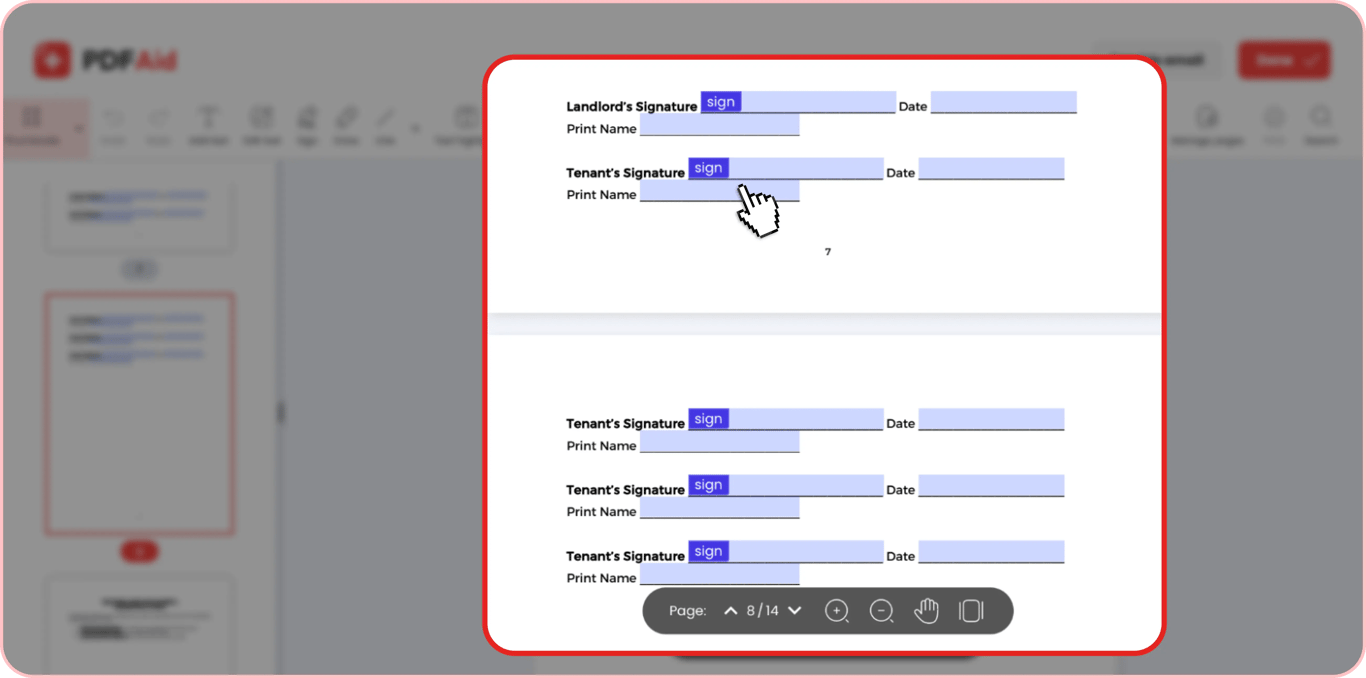
Although our form is printable, which means that you can print an agreement and sign it manually, our editor lets you electronically sign the document and send it to the second party for signing. Electronic signatures are legally valid in Texas under the Texas UETA.
Here’s how to sign your agreement using PDFAid:
Fill in all form fields and verify data correctness.
Scroll to the very bottom of the page to find a Signature block.
Click on the Sign button and draw, upload, or type your signature. Then type the signing date and your full name.
Send the link to your agreement to the second party by entering their email for signing.
Types of Texas Lease Agreements
Lease agreements in Texas take several forms depending on the property type, agreement parties, and lease goals. We’ll cover:
Texas Realtors Residential Lease
Texas Residential Lease Application
Texas Commercial Lease Agreement
Texas Land & Agricultural Lease Agreement
Texas Realtors Residential Lease
Texas REALTORS® (TXR) is a professional organization that represents real estate professionals across the state. It is affiliated with the National Association of REALTORS®.
Texas REALTORS® frequently publishes standardized lease forms for different types of transactions. These templates are provided exclusively for authorized use and contain standardized terms for residential rental transactions.
Examples of available TXR forms:
Form | Residential Lease |
|---|---|
Texas REALTORS® Number | TXR 2001 |
Purpose | The Texas Association of Realtors residential lease form is a contract that establishes standard lease terms, rent, deposit, and liability for residential leases. |
Form | Pet Agreement |
|---|---|
Texas REALTORS® Number | TXR 2004 |
Purpose | A document that acts as an addendum to the original lease agreement and provides clarifications/changes to the pet policy (e.g., it can authorize a tenant to keep a pet and establish an additional pet fee). |
Form | Extension of Residential Lease |
|---|---|
Texas REALTORS® Number | TXR 2005 |
Purpose | A short document used for extending an existing lease before it expires. |
Texas Residential Lease Application
A residential application is a standard document used for tenant screening before signing a lease agreement. Landlords and real estate agents collect these forms from potential tenants to verify their personal, rental, and financial information.
The main sections included in a lease application are:
Personal information
Employment
Income
Previous landlords
Consent to credit and criminal history checks
Texas Commercial Lease Agreement
A commercial lease agreement is a contract that allows tenants to rent property for commercial activities. Examples include the lease of offices, storage spaces, and stores. The main differences between a commercial and residential lease include:
In commercial leases, one or both parties may be legal entities.
Such contracts are governed under the Texas Property Code Chapter 93 (Commercial Tenancies).
Tenants in commercial leases often pay base rent, which may be calculated as a price per square foot per year and paid monthly. Base rent may exclude some or all of the building’s operating expenses, depending on the lease structure.
In triple-net leases, tenants generally pay base rent plus specified operating expenses, which may include property taxes, insurance, and maintenance costs.
The duration of a commercial lease is typically longer (3-10 years) and doesn’t automatically renew, so the renewal terms must be specified in the agreement.
Commercial leases commonly include a Permitted Use section that strictly limits the types of activities permitted on the premises.
Texas Land & Agricultural Lease Agreement
Land and agricultural lease agreements are legally binding contracts that allow tenants to rent and/or use private or state-owned land for different purposes. There are two primary types of such agreements:
Pasture/crop-share lease – A contract under which the landowner allows a tenant to use their land for pasture or crop purposes. Often, such agreements imply that the landowner will share some production expenses with the tenant and receive a predetermined percentage of the harvested crops, hay, or livestock revenues.
Hunting lease – A contract or license that provides tenants with access to private land for hunting. Typically, such contracts allow hunting for specific game during a specific time period.
Both pasture/crop-share and hunting leases in Texas come with additional requirements:
Property liability and damage | |
Pasture/Crop-Share Lease | If the landlord receives a revenue share, they are considered actively involved in agricultural activities and share liability for damage with the tenant. The contract may include a Liquidated Damages clause that determines fees for damage caused by the tenant’s negligence. |
Hunting Lease | Hunters bear full liability for damage caused by their actions (e.g., campfires, accidental shots, etc.). |
Insurance | |
Pasture/Crop-Share Lease | In this type of agreement, landlords often require tenants to have Commercial General Liability (CGL) insurance with the landlord listed as an “Additional Insured.” |
Hunting Lease | Hunters or clubs can purchase specialized hunting insurance. |
Construction/improvements restrictions | |
Pasture/Crop-Share Lease | A tenant is usually free to perform minor repairs and improvements at their own expense. Major improvements and construction are covered by a Provision for Reimbursement – if the contract is terminated before the new structure is depreciated, the landowner is obliged to pay the tenant its residual value. |
Hunting Lease | Hunters are allowed to install temporary structures (e.g., tree stands, hunting blinds, and others) if they will completely dismantle them afterward. Capital construction is strictly prohibited. |
Texas Month-to-Month & Rent-to-Own Lease Agreements
One year is a common length of a residential lease in Texas. It primarily applies to long-term living with no transfer of ownership. However, this contract duration is not suitable for all situations, which is why there are alternative agreements, such as month-to-month and rent-to-own.
Texas Month-to-Month Lease Agreement
A month-to-month lease is a flexible rental agreement. Its initial duration is 30 days with the option of automatic renewal every month. Unlike a general residential lease, it doesn’t have a predetermined end date. Yet, either party may generally terminate the tenancy by giving at least one month’s notice, unless a signed agreement establishes a different notice period.
This type of lease is frequently chosen by short-term tenants (e.g., people who are traveling), people who need a transition period before finding long-term rent or purchasing property, and expats. Its primary pros and cons include:
Pros:
Maximum flexibility
No long-term commitment for either the landlord or the tenant
Cons:
Less stability because of a simple withdrawal mechanism
Typically higher cost
Texas Lease Purchase / Rent-to-Own Agreement
A Texas lease-to-own agreement is a special, two-phase contract that allows the tenant to buy the property they are renting. Depending on the contract format, purchasing the property on a rental basis can be an option or an obligation. In both cases, this kind of lease works differently from a standard one – there often is an upfront fee, and the monthly rent is higher because a portion of it is credited toward the future down payment. If there is an obligation to buy, the agreement typically provides a specified term after which a tenant has to step into ownership. Some Texas rent-to-own arrangements may qualify as executory contracts and be subject to additional requirements under Texas Property Code Chapter 5.
Upfront cost | |
Rent | Lower; only includes:
|
Rent-to-Own | Higher; includes standard upfront costs + a non-refundable Option Fee (1-5% of the property price) |
Monthly rent | |
Rent | Standard market price – between $1,237 and $1,860 in Texas, depending on the city and property type |
Rent-to-Own | Standard price + a monthly premium credited toward the future down payment |
Maintenance | |
Rent | The landlord is often responsible for handling repairs |
Rent-to-Own | The tenant might be obliged to handle and pay for repairs |
Texas Lease Extension Agreement
An extension agreement is a new document signed to extend an existing lease agreement, typically 30-90 days before it expires. Instead of drafting a completely new contract (lease renewal), landlords and tenants sign a short-form document that extends the lease duration and introduces changes to the previous contract if needed.
Here’s how to fill in a Texas realtor's extension of residential lease (TXR 2005):
Step 1. Give reference to the original lease contract at the top of the form.
Step 2. Provide full legal names of the landlord and tenant.
Step 3. Specify the full address of the property.
Step 4. Indicate the original lease date.
Step 5. Introduce the new start and end date (the extension period).
Step 6. If the rent changes, indicate the new monthly amount and the start date for the new rate.
Step 7. Specify a new sum of late, pets, and other fees that are expected to change.
Step 8. Fill in the Other Changed Terms sections if any new living rules apply to the lease, or type "N/A" if the terms remain the same.
Step 9. Sign the document to confirm both parties’ agreement to the extension terms.
Get the most current Texas Residential Lease Agreement - Legal Contract for Renting Property in Texas form now
Up-to-date • Fillable • Ready to sign online