Get the most current Bill of Sale form now and subscribe to download
A general bill of sale is an official document when you buy or sell personal property. With PDFAid, you can fill out, edit, sign, and download your document in your browser. Just enter information and get a ready-to-print PDF in minutes.
What Is a General Bill of Sale?
A General Bill of Sale is a written document that proves you bought or sold an item. This legal bill of sale form is official proof of the transfer of ownership from the seller to the buyer for a specific price. Its legal meaning is simply that your agreement is officially recorded. However, it cannot replace a title transfer for cars or boats.
This overview is not legal advice.
What Information Is Included in a General Bill of Sale?
When you prepare this document, make sure it clearly outlines the terms of your transaction. Knowing exactly what you need for a bill of sale helps you gather the right details before you start. The actual contents of a bill of sale protect both parties from future arguments. You should use clear verbiage to avoid any confusion.
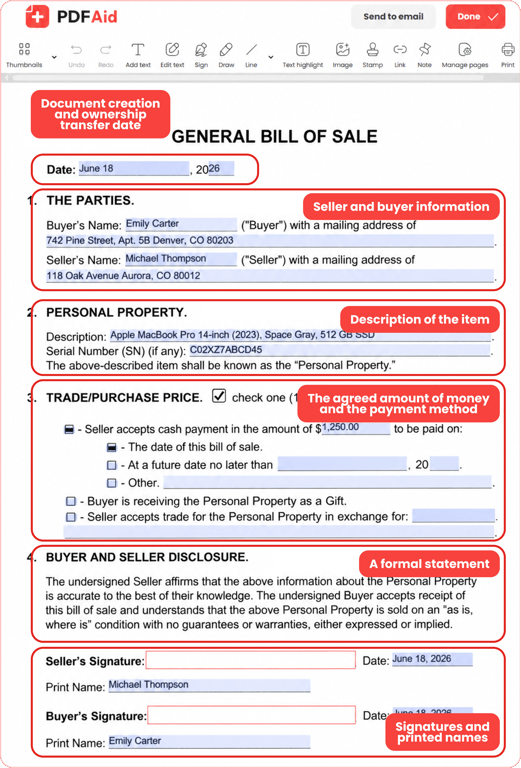
Field | Date |
|---|---|
What to Enter | The date when you create the document and transfer ownership. |
Field | The Parties |
|---|---|
What to Enter | Seller and buyer Information (Full names and physical mailing addresses) |
Field | Property Description |
|---|---|
What to Enter | A detailed description of the item: its make, model, color, and unique identifiers. |
Field | Identification Numbers |
|---|---|
What to Enter | Any unique identifiers, such as a serial number, model number, or VIN. |
Field | Trade or Purchase Price |
|---|---|
What to Enter | The agreed amount of money in U.S. dollars and the payment method (cash/bank transfer). This section also notes if the item is a gift or a trade. |
Field | Buyer and Seller Disclosure |
|---|---|
What to Enter | A formal statement confirming that the seller officially owns the property and has the legal right to sell it. |
Field | Signatures and Printed Names |
|---|---|
What to Enter | The handwritten signatures and printed legal names of the parties. |
You can also add custom clauses to your document to fit your specific situation. Many sellers choose to include an "as is" disclosure. This means the buyer accepts the item in its current condition, and the seller offers no warranty. If you are creating a bill of sale with payments spread out over time, you can outline a structured installment plan. In this section, make sure to record the exact down payment you already received and set clear deadlines for the remaining balance.
How to Write and Fill out a General Bill of Sale (Step by Step)
Create a bill of sale with our editor that lets you fill out every field on screen before printing the page.
How to make a bill of sale step by step:
Step 1. Gather the parties' details: full names and physical addresses.
Step 2. Describe the property: Provide details about the item. Write down the brand, model, color, and any unique serial or model numbers.
Step 3. State the price and payment method: Record the exact amount of money being paid. Note whether the buyer is paying with cash, a check, or a bank transfer.
Step 4. Add optional clauses: Include an "as-is" statement if the seller will not provide a warranty. This means the buyer accepts the item in its current condition.
Step 5. Enter the date when the deal takes place.
Step 6. Collect the signatures: Both people must sign and print their names. Leave space for a notary public if your state requires one for this type of property.
Note: Drafting a handwritten contract on a blank sheet of paper is completely legal. However, choosing a simple template over learning how to write a handwritten bill of sale from scratch saves time. It guarantees you never miss critical lines that protect your money.
General Bill of Sale Sample (Filled-Out Example)
Reviewing a filled-out sample is the easiest way to understand the layout. If you want to know what a bill of sale looks like, it is a simple document divided into clear sections. This example highlights all the spots for personal details, item descriptions, and the final price. Checking a realistic example of a bill of sale text helps you organize your information before you print your paperwork.
Selling "As Is" — The No-Warranty Clause
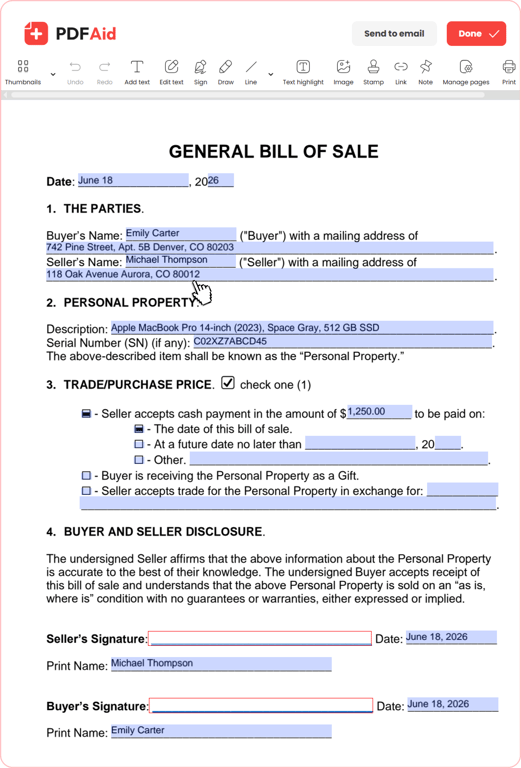
Using a bill of sale “As Is” template protects both sides during a private sale. It means the buyer accepts the item in its as-is, where-is condition, flaws and all. The seller makes no promises about its future performance and offers zero warranties. This simple “As Is” setup shields the seller from angry complaints if the item breaks down after the exchange. For the buyer, this means you must inspect the property thoroughly before signing the printable form. Once the deal is complete, you cannot legally demand a refund or ask the seller to pay for repairs.
Standard "As Is" Clause:
"The item is sold as is, where is, with no guarantees or warranties, either expressed or implied."
What Can You Use a General Bill of Sale For?
You can use a general bill of sale for almost any type of personal property that does not have its own special government form. Our PDFAid editor makes it simple to customize this document for many kinds of private sales.
General Goods & Personal Property
People most often use this document when they clear out their homes or sell old belongings. If you are selling household furniture, a laptop, or a bicycle, a personal property bill of sale is the perfect way to create a clean paper trail. Since these everyday items do not have official state titles, this bill of sale for goods acts as your main proof of ownership.
Individual Items
You can use this form whenever you sell a high-value standalone item that lacks a special state document. For example, if you sell a power generator, a high-end camera, or a musical instrument, this form protects both sides. It allows you to record the exact serial number of that object, so there is no confusion later about what was traded.
Parts & Equipment
Private parties frequently use this document when trading mechanical components or expensive tools. It works perfectly for selling vehicle parts, lawnmowers, air compressors, or welding gear. Listing the exact model and condition ensures both sides agree on the state of the equipment during the swap.
Business Assets
Companies often use this form when they upgrade their workplace or clear out older equipment. You can use it to transfer ownership of business computers, office desks, or retail display cases. However, if you are selling an entire company rather than just a few physical assets, you will need a separate, more comprehensive commercial purchase agreement instead.
Do You Need to Notarize or Sign a Bill of Sale?
Your agreement usually becomes active once the buyer and the seller sign the document. While signatures are required, you do not always need a notary public to make the paperwork official.
Signing a Bill of Sale
Both parties must make sure the document is signed to finalize the deal. If you want to sign a bill of sale quickly, you can use an electronic signature instead of printing out physical paper. Our online form makes it simple to create a clean digital bill of sale. You can fill out, sign, and download your document completely online using the PDFAid editor.
Notarizing a Bill of Sale
For most everyday items, your transaction requires no notary to be valid. You can use a bill of sale without a notary stamp when transferring items such as furniture or tools. However, the rules depend on your local state laws. In some states, government agencies might require a notary public or extra witnesses for high-value items. Always check your local guidelines before finalizing the paperwork.
General Bill of Sale by State
Legal rules change depending on your location. You should always check the specific bill of sale by state guidelines before you finalize your paperwork.
If you are selling a motor vehicle, a basic receipt is rarely enough to satisfy local laws. The DMV or local transit office in your state usually requires a highly specific form. This form includes specialized fields like odometer readings and damage disclosures.
A bill of sale is not the same as a title transfer. A bill of sale is a receipt that proves a financial transaction occurred. It does not grant legal ownership by itself. For items that require state registration, you must still complete a formal title transfer with your local government agency to officially register the new owner.
General vs. Specific Bill of Sale
A standard bill of sale form is a generic document designed to cover a wide variety of everyday property. People often look for this type of universal paperwork because it does not focus on one category of goods. You typically use it when your local government does not mandate a highly specialized document for the asset you are trading.
When to use a general form: This option is ideal for untitled furniture, electronics, yard tools, and musical instruments.
When to use a specific form: You will need a specialized document for major assets (cars, trucks, watercraft, or trailers). These forms include mandatory fields for state tracking codes, like a vehicle identification number.
Get the most current Personal Property Bill of Sale Details and Procedure form now
Up-to-date • Fillable • Ready to sign online