Get the most current Affidavit Form and subscribe to download
A general affidavit is a common written statement of facts signed by an affiant under oath before a notary public. Fill out, edit, and sign this editable online form directly from your browser without downloading any software. You can download the final PDF immediately to make printable copies for your notary appointment. Remember that this page is not meant for legal advice.
What is a General Affidavit?
A general affidavit is a written statement of facts that you declare to be true. Businesses, government, and courts all accept this document as legal evidence. Unlike specialized legal forms, a general affidavit lets you formally state specific facts or circumstances in a flexible layout.
The affiant/deponent is the one who writes and signs this document. You, as the affiant, are responsible for making sure that all the facts stated on the document are true. Your signature makes the statement more trustworthy than a letter or written declaration.
The core legal feature of this document is that you make it under penalty of perjury. This means that if you knowingly include false statements, you will face criminal penalties. This legal weight allows courts, banks, and immigration offices to trust and accept the document.
Affidavit meaning and legal definition
The word affidavit comes from the Medieval Latin verb affidare, which means "to pledge". In fact, the affidavit translates to “he or she has made a pledge.”
This document is different from an ordinary written statement. Anyone can write a regular note, but without a formal oath, it carries no legal power.
An affidavit is a written statement of facts that is made under oath and is on the same level of legal weight as sworn oral testimony.
Who makes an affidavit, and what is an affidavit used for
Anyone with firsthand, personal knowledge of specific events can write an affidavit. A notary public should witness how the affiant (The writer) signs the document.
You can use these sworn statements in many common scenarios:
To support active court cases and lawsuits.
To verify personal information for government agencies.
To confirm official identity or residency details for financial institutions.
To create a formal, permanent record when you cannot testify in person.
To settle business or transaction disputes.
What a General Affidavit form contains
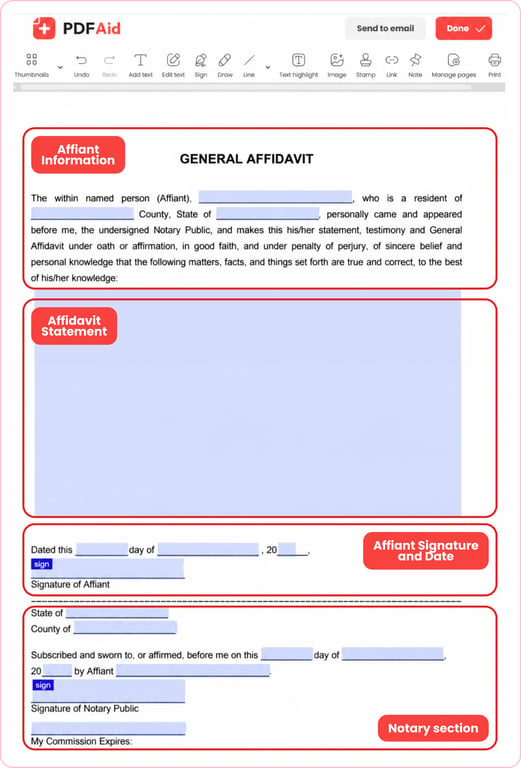
What does an affidavit look like? A standard affidavit format has clear sections to move from your personal statement to the official notary verification. Each part ensures your document is complete and accurate:
Affiant Information: your legal name, county, and the state where you live.
Affidavit Statement: the section where you write all the facts, and you swear they are true.
Affiant Signature and Date: your signature and the date you sign the form.
Notary Section: the state and county where the notary public verifies your form. This part contains the notary's official attestation, which is their witness signature, and the license expiration date to prove their active authority.
Affiant statement and sworn declaration
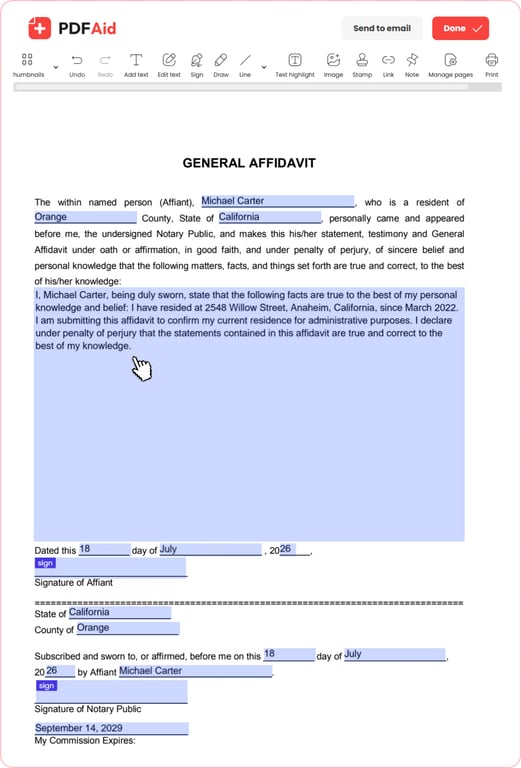
The main body of your document is the statement of facts. This is where you describe the events you declare to be true. You must write this declaration in good faith and base it entirely on your firsthand knowledge.
Note that these written statements are sometimes referred to as an Affidavit of Fact or an Affidavit of Truth. The terms Affidavit of Fact and Affidavit of Truth are often used interchangeably to describe a written statement of facts made under oath or affirmation. Regardless of the title, the affiant declares that the information provided is true to the best of their knowledge.
A standard opening statement:
"I, [Your Name], being duly sworn, state that the following facts are true to the best of my personal knowledge and belief..."
Notary/jurat block
A jurat is the official certificate a notary public completes after you sign the document under oath. It is different from a regular acknowledgment. In a jurat, you swear that the content of your document is true. The acknowledgment only confirms your identity and that you signed willingly.
A standard notary affidavit block should include:
State and County: The exact location where you notarize the document.
Jurat statement: The formal sentence confirming the execution, for example, "Subscribed and sworn to before me".
Date of notarization.
Affiant name: The name of the person making the statement.
The official signature of the notary public.
The notary's official stamp or seal.
Notary commission info: The notary's license expiration date. Our template uses the label "My Commission Expires" for this section.
How to fill out a General Affidavit
Our tool lets you fill out a blank affidavit online. You don't need to print the paper first. The platform lets you customize all fields digitally, so your final document is clean and easy to read.
Follow these steps to prepare and write an affidavit using our online editor:
Select a pre-made template on our platform or upload your affidavit form in PDF.
Enter the affiant information: your name, county, and state.
Write the affidavit statement: List your facts in the order they happened. State only objective details, names, and dates that you know personally.
Add the date: Insert it into the specified execution fields.
Save and download the file: Check all fields for accuracy. Save your work, and then download the finished PDF to your device.
How to sign and notarize a General Affidavit
You need to confirm the information and sign the document in front of a notary public. The notary will first check your identity and make you take an oath. After that, the notary will personally sign the document. This makes your document an official affidavit that you can use as proof.
Your state's laws regarding notarization can vary greatly, so check your state's notarization rules before you write a document.
There are several methods you can use to sign the sworn affidavit:
With a notary in person.
With a notary online through a video call.
Use an e-signature if your state allows it.
Do you need a notary?
Yes. Most affidavits must be notarized to be valid. This is because the document requires a formal oath before an authorized official. Without this official verification, banks and courts usually will not accept your paper. The exact rules depend on your state and how you plan to use the document.
You have three main options to get an affidavit notarized:
Traditional Notarization. You visit a local notary and sign the paper by hand in front of them.
Remote Notarization. You verify your identity and sign the document digitally over a video call with an approved online notary.
Unsworn Declaration. You skip the notary. You can only do this if your state rules allow you to use a signed statement under penalty of perjury instead.
Self-proving affidavit and jurat
A self-proving affidavit is a form you attach to a last will and testament. You and your witnesses sign it in front of a notary to prove your will is real and valid. This step saves a lot of time during the court process later.
A self-proving affidavit allows the judge to accept the will automatically, without forcing your witnesses to come to court and testify in person. This document always uses a jurat because everyone must swear under oath that the information is true. A regular notary acknowledgment only proves your identity, but a jurat requires this official, sworn oath.
A self-proving affidavit is a sworn statement that validates a will, so your witnesses do not have to testify in court later.
Types of affidavits (overview)
An Affidavit of Support proves you will financially support another person for immigration purposes.
A Small Estate Affidavit lets heirs claim or transfer property if the estate is relatively small.
An Affidavit of Residency or Domicile confirms where a person lives.
An Affidavit of Heirship identifies legal heirs. It helps families avoid going to probate court.
An Affidavit of Gift is a document that proves you gave away money or property for free.
An Affidavit of Title proves you own a piece of property. This document also lists any issues with the property.
A Financial Affidavit documents your current income, assets, debts, and monthly expenses.
An Affidavit of Paternity officially says who the legal father of a child is.
An Affidavit of Service proves that legal court papers were delivered to the person.
An Identity Theft Affidavit says that a criminal stole your data to commit fraud.
Get the most current Affidavit Form form now
Up-to-date • Fillable • Ready to sign online