Get the most current Loan Agreement form now and subscribe to download
A loan agreement form is a standardized document template that formalizes money-lending agreements and outlines the loan amount, repayment schedule, interest rate, and penalties (if any) for missed payments. This formal, legally binding document can come in handy when a loan is agreed upon verbally, even between friends or relatives. Its goal is to outline the terms and protect both sides of the agreement.
If you don’t know how to build this agreement from scratch, you will find a fillable loan agreement form on our platform. The form covers all essential elements of a loan agreement and can be filled out online directly in the browser.
What is a loan agreement (loan contract)?
A loan agreement (also known as a loan contract) is a document that details the terms of the loan and the mutual promises made by each party. The parties of such an agreement are a borrower and a lender:
Definition | |
Borrower | A person or entity that receives the funds. |
Lender | A person or financial institution that provides the funds. |
Main responsibilities | |
Borrower |
|
Lender |
|
Main rights | |
Borrower |
|
Lender |
|
Key risks | |
Borrower |
|
Lender |
|
A loan agreement is needed to:
Establish clear terms and expectations: A formal contract clarifies all the details of the loan, including who lends money, who receives it, when and how the debt should be repaid, and other details. This helps avoid misunderstandings.
Define what happens if something goes wrong: A written agreement details the consequences, such as additional fees and penalties, in the case of late or missed payments.
Protect assets involved in a secured loan: If there is collateral for a loan, such as a house or vehicle, the contract documents should specify which assets are involved and how the lender can obtain them in the event of non-payment.
Preserve relationships: Verbal loan agreements, especially with family and friends, often result in disputes and fractured relationships if something goes wrong. A written contract helps make the money lending agreement strictly professional and minimizes the potential damage to relationships.
Provide legal protection: Handshake deals are often hard to enforce because there is no proof of a loan and related mutual promises. Formalizing them with a contract helps create a legal framework to protect both parties.
Loan agreement vs promissory note
When there is a money-lending agreement, a loan contract is not the only document used to legally bind a borrower to repay the debt. A promissory note is another common document. However, they aren’t the same.
Nature | |
Promissory note | One-sided promise to pay |
Loan agreement | Mutual agreement |
Who signs it | |
Promissory note | Only the borrower |
Loan agreement | Both the borrower and the lender |
Terms covered | |
Promissory note | Minimal. Notes usually state the basic loan details, such as the amount, interest rates, and due dates. |
Loan agreement | Extensive. A contract details a repayment schedule, financial restrictions, reporting rules, and other important provisions of the agreement. |
Legal protection | |
Promissory note | Mainly protects the lender from non-payment. |
Loan agreement | Protects both parties by locking in the terms, costs, and obligations. |
Best for | |
Promissory note |
|
Loan agreement |
|
There are two more related terms in money lending:
Credit agreement – A general umbrella term that covers all cases in which a lender provides access to money or credit for a borrower. Technically, all loan and facility agreements are types of credit agreements.
Facility agreement – A specific type of heavy-duty, commercial credit agreement. Often used by banks when providing massive corporate revolving lines of credit to large businesses.
When you need a loan agreement
A written contract may not be strictly mandatory in all money-lending situations (especially in personal ones). Yet, a well-formulated document provides the lender with concrete proof of the debt and the borrower with clear terms that can prevent sudden loan acceleration and other violations of their rights. Respectively, entering into a loan agreement is important for protecting all parties to the agreement.
Here are several real-world cases when it’s mandatory or highly recommended:
Personal loans to friends or family. A formal agreement with clear terms of repayment can help avoid misunderstandings and retain relationships, but that’s not all. Without a written agreement, the IRS may classify the loan you give to a friend/relative as a gift, triggering avoidable gift taxes.
High-value loans. Some states mandate that any loans that exceed a certain monetary threshold must be documented in written form. For example, in Texas, a loan over $50,000 may be considered unenforceable if it’s not in writing.
Loans that involve real estate or collateral. Real estate loans, such as a mortgage, are typically required to be in writing to be enforceable. The statute of frauds also requires a written agreement for all secured loans, unless the collateral is physically transferred to the lender, until the time the borrower pays off their debt.
Business loans. A verbal agreement may be enforceable in limited cases, such as when a business owner receives a loan from another individual (not an entity). Yet, many business loans are provided by banks, commercial lenders, and government programs. These cases typically require a formal, written contract.
Types of loan agreements
Loan agreement types vary depending on the parties involved, collateral, and purpose. Below is an overview of the most common types.
Personal & family loan agreements
A loan agreement between friends or family members is considered personal. It typically doesn’t require a written agreement. However, it can help prevent miscommunicated terms and deadlines, which frequently lead to disputes and fractured relationships. Also, lending money to someone you know without an agreement can potentially trigger additional taxes.
If you decide to enter into a contract when lending to a family member or friend, remember that keeping things formal provides maximum protection for everyone. So be sure to include all essential details, including the full legal names and mailing addresses, the real loan amount, a clear repayment schedule, grace periods, late fees, governing law, and signatures. Also, be sure to indicate the interest rate. Even if you are not going to charge it, indicating the minimum market rate will prevent the IRS from classifying the loan as a taxable gift. According to the latest applicable federal rates (AFRs) rulings for August 2026, the minimum adjusted interest benchmarks (annual) are:
3.10% for short-term loans
3.29% for mid-term loans
3.72% for long-term loans
Business, LLC & corporate loan agreements
Corporate and business loans are much different from private agreements. They are typically signed by an authorized corporate officer, for example, a CEO or manager. Yet, the primary debt obligation is carried by the business, not the individual who signed an agreement. Also, such loans focus more on regulatory compliance and corporate risk management, rather than on the repayment schedule. For this reason, a business loan agreement is usually more robust and includes strict additional terms, such as financial covenants and mandatory delivery of audited financial statements to confirm the financial health of the business at different stages of the loan’s lifespan.
Common loan types that fall into this category include:
Commercial loan: A generalized term used to define loans by banks or institutional lenders to businesses with the goal of funding their operational costs, expansion, and major capital expenditures.
Business loan: Also a generalized term that basically means the same as a commercial loan. However, business loans usually cover smaller, daily operational needs and are simpler than commercial loans, which are often large and collateral-heavy.
LLC loan: A loan designed specifically to fund a Limited Liability Company. In such agreements, lenders often require a separate Personal Guaranty signed by one or more LLC owners, making those guarantors personally responsible for specified loan obligations.
Shareholder loan: A loan provided from a corporation to one of its shareholders or vice versa. These agreements often require more formality and attention to prevent the IRS from classifying a loan as a disguised corporate distribution or taxable dividend.
Secured & asset-based loan agreements (car, mortgage, equipment)
A secured loan implies that the borrower pledges some high-value asset as collateral to back up their debt. In this case, collateral acts as the protection for the lender. In the case of default, the pledged asset can be seized and sold to cover the loan balance. Such loans often come in larger amounts and have lower interest rates because the lender has a safety net.
Common types of secured loans include:
Mortgage and home equity loan agreement: The borrower pledges their property to the lender.
Car loan contract: The borrower purchases a vehicle using the loan money and pledges it as collateral.
Equipment loan agreement: Applicable to businesses; an entity takes out a loan to purchase heavy machinery, vehicles, or technology, which also serves as the collateral.
Student & education loan agreements
The last common loan type is a loan designed specifically for educational purposes. Such loans are provided to students to help cover their tuition and additional education-related expenses. An educational institution, governmental program, or a private commercial bank can provide financing in this case.
Key sections of a loan agreement
A standard loan agreement format consists of 14 sections:
Loan amount: The header section located at the top of the document that specifies the total amount of the loan and the date of the agreement.
The parties: Provides full names and mailing addresses of the borrower and the lender.
Payment: Indicates the selected repayment system and details the sum of payments and deadlines for them.
Interest: Clarifies if the interest rate applies to a particular agreement and indicates the percentage of interest.
Prepayment: Clarifies the borrower’s right to make additional payments or pay back the loan in full before the indicated deadline without penalties.
Remedies: States that a delay or omission the lender lets slide once does not waive the lender’s rights and remedies.
Events of acceleration: Details specific events (e.g., the borrower’s failure to pay the interest rate) that will lead to loan acceleration.
Acceleration: Clarifies the lender’s right to declare the agreement immediately due and payable if any event of acceleration described in the document takes place.
Subordination: Indicates that a particular lender agrees to follow the “first in line rule” and let the borrower pay out their previous debts first in the event of bankruptcy or a worsened financial situation.
Waivers by borrower: Communicates the borrower’s consent to give up on their right to receive formal notices or updates about the loan, and not use it as an excuse to stop paying. This clause also means that the borrower agrees that the lender can make changes to the loan without their notice or consent.
Expenses: Clarifies that the borrower is bound to cover additional expenses, such as reasonable attorney fees, in the case of non-payment that forces the lender to exercise any of their rights.
Governing law: Indicates the state that will govern a particular agreement.
Successors: States that the borrower’s successors, assigns, and heirs might also be bound by this agreement and the obligations stated in it.
Signatures: A formal place for parties and witnesses to put their signatures.
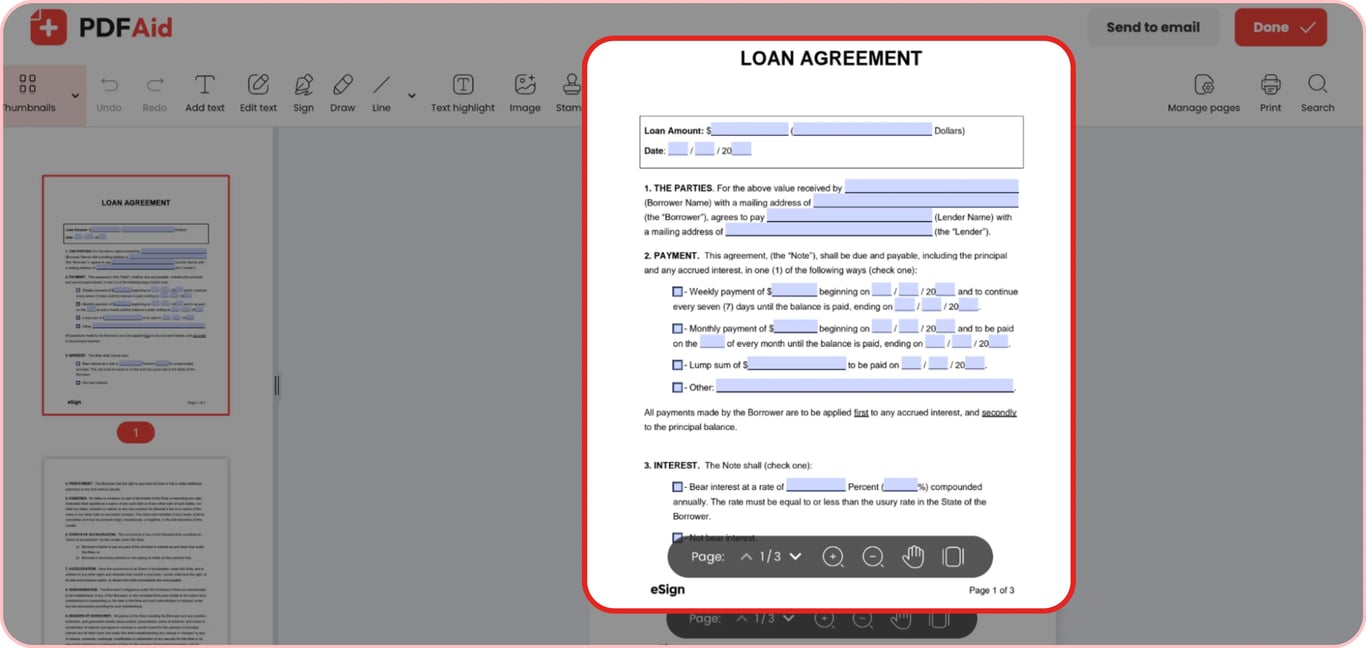
Loan amount & parties
At the top of the agreement, you have a header box that instantly demonstrates the total amount of the loan and the date when the agreement between the two parties was made. The sum must be indicated both as a number and in words.
Right under the header, there is the Parties section. If the agreement is made between individuals, you should include the full legal names of the borrower and lender (as stated in their IDs) and mailing addresses. If one (or both) of the parties is a business, you need to state its exact legal name, entity type, and principal address.
Payment terms & interest
After identifying the parties, a loan agreement must clarify the payment terms that the parties agree upon. Typically, an agreement template offers several standard options, such as weekly, monthly, and lump sum payments. For each, you can clarify the payment deadline and the sum to be paid. If none of these payment terms suits you, you can also clarify your own repayment terms. At the end of this section, there is typically a statement that clarifies the order of payment – the amount paid is first applied to interest and then to the principal amount.
In the next section, you need to choose if the loan implies additional interest and specify the percentage if yes. If you are the lender, it’s important to check state caps on interest to prevent applying a usury rate.
Prepayment, remedies & acceleration
The next three important sections of a standard loan agreement are interconnected. The Prepayment, Remedies, and Acceleration clauses communicate how and when the borrower can pay the loan off early, what events can trigger an immediate demand for a full repayment, and how the lender can exercise their rights through legal action.
The Prepayment section clarifies whether the borrower can repay the loan before the established deadline. In most standard personal and small business loans, repayment is possible at any time, without penalties. Some commercial and real estate loans (e.g., a mortgage) can apply a fee for payoff ahead of schedule to prevent lenders from not getting the full amount of expected interest.
The Remedies section is used to protect the lender’s right to deploy their contractual remedies at their own discretion. This section states that the lender might overlook some violations of the agreement, such as a late payment, at any time during the loan duration, but this doesn’t mean that they waive their rights.
The Acceleration of a loan is the event when the lender can immediately demand a full repayment ahead of schedule. The Events of Acceleration section clarifies the specific events that can trigger this, such as a failure to pay, breach of covenants, transfer of collateral, and others. This clause remains in effect unless the borrower and lender sign a waiver of the loan default agreement – a separate legal document where the lender agrees to give up on their rights (temporarily or permanently) to penalize the borrower for a specific violation of the contract.
Collateral, governing law & signatures
The Collateral clause is not included by default in every loan agreement, especially if it’s a personal agreement. It applies only if you are making a secured loan that protects the lender’s interests by offering pledged collateral that they can seize and sell in the case of non-payment. In this case, the Collateral clause describes which valuable asset (e.g., a house, savings account, or vehicle) the borrower pledges to the lender.
This clause can be added to both a recourse and a non-recourse loan agreement. These are the two types of secured loans. The difference between them is in the power the lender has in case you fail to pay: a recourse loan enables the bank to take both the collateral described in the contract and other personal belongings, whereas a non-recourse loan only lets the bank take the collateral.
Another optional section is Financial Covenants, which typically applies to commercial and business loans. The goal of this clause is to protect the lender’s capital by establishing legally binding covenants that require the borrower to maintain specific operational conditions or financial metrics throughout the loan's term. For example, this can include a requirement to maintain a minimum cash balance or a ban on taking on additional loans.
The following sections: Subordination, Governing Law, Successors, and Signatures, are usually included in all loan agreements. The Subordination clause clarifies the order of debt repayment in the event of bankruptcy or bad financial standing of the borrower. The Successors clause gives the lender the legal right to transfer the loan obligations to the borrower’s heirs. And the Governing Law must be indicated to communicate which state’s laws and courts will ensure the contract’s enforceability.
Finally, the section with signatures of the lender, borrower, and a notary public and/or witnesses is there to bring the contract into legal force. Everyone who signs the contract must also write their name and the date of signing.
How to fill out and sign a loan agreement online
Our platform gives you a fast and convenient way to get a comprehensive loan agreement in under two minutes. To do this, fill out our ready-made loan agreement template with your data and terms, sign it, and export the final document as a PDF. The following sections will guide you through this process step by step.
Step-by-step: filling the form
On our platform, you can create a comprehensive loan agreement without downloading or installing additional software. Here’s how to complete our form step by step:
Step 1. Go to the Loan Agreement Form page on our website and click Get Form. Our PDF editor will instantly open with the current version of the form ready for you to fill in.
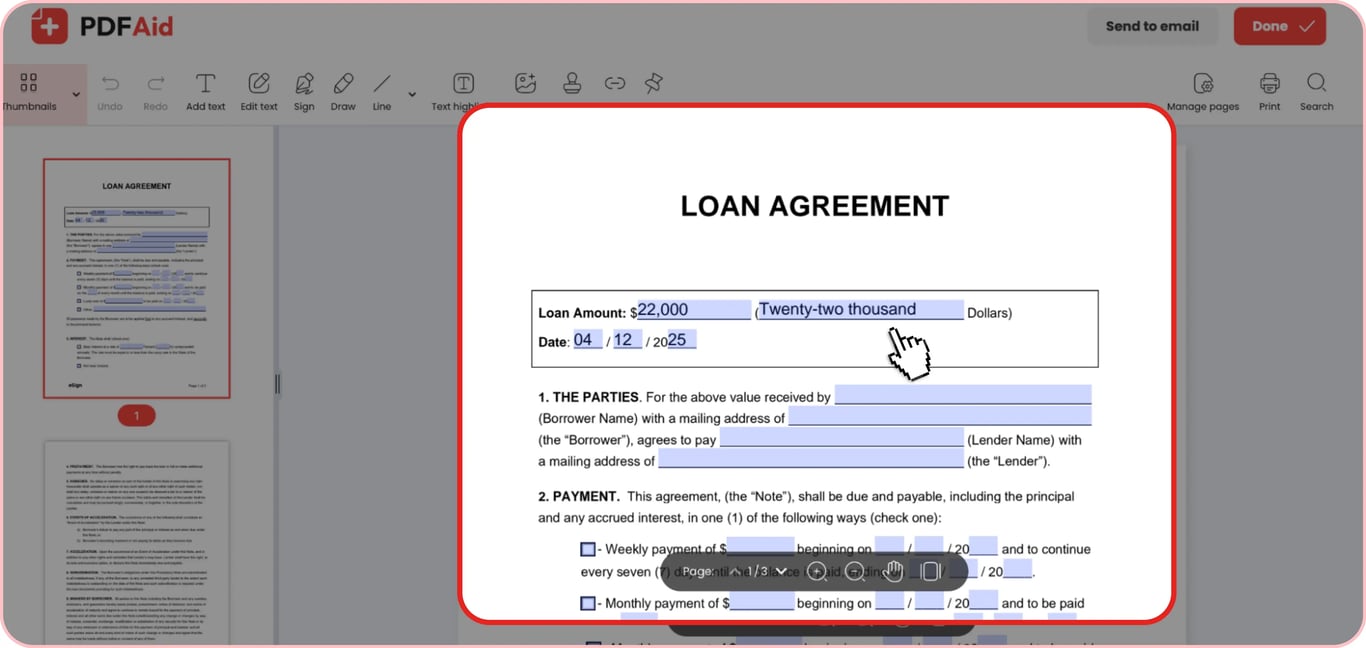
Step 2. Fill in the header of the form by indicating the total sum of the loan (both as a number and in words) and the date of the agreement.
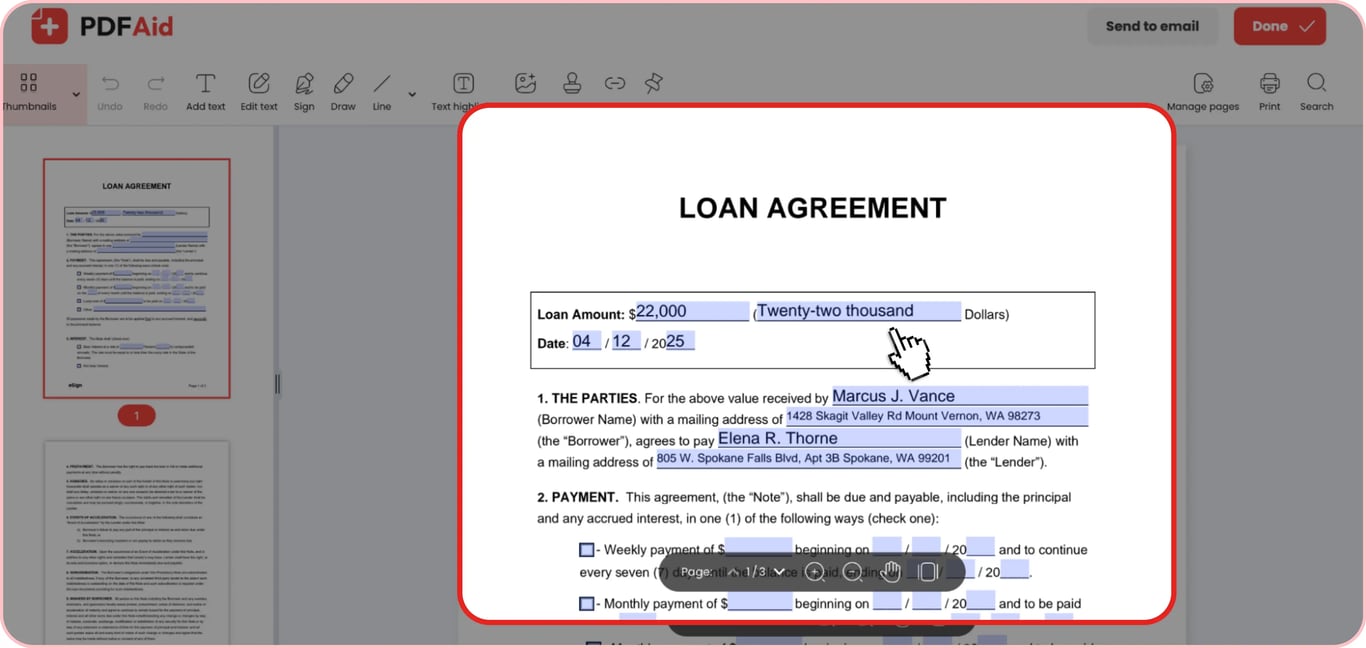
Step 3. Complete the information about the parties to the agreement. Provide full legal names and mailing addresses of the borrower and lender.
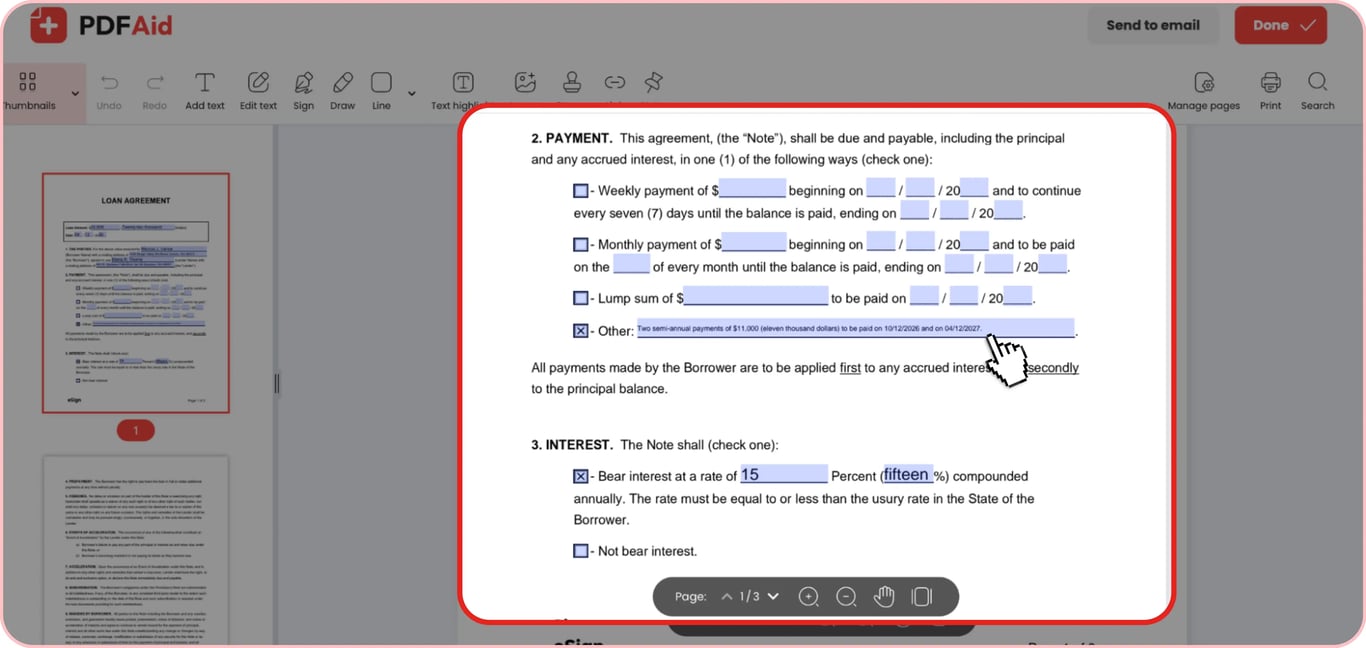
Step 4. Complete the Payment and Interest sections. First, check the box for the preferred loan repayment form (e.g., Weekly, Monthly, Lump Sum, or Other), then indicate the start day of payments and the payment deadline. If you select Other, provide a clear explanation of the payment schedule. In the Interest section, indicate whether the agreement will bear interest and indicate the specific percentage if applicable.
Step 5. Indicate your state of residence in the Expenses and Governing Law sections.
Step 6. Check the provisions of the agreement and the provided data for correctness. Then click Done in the upper-right corner to export the filled-out document.
Please note that our form is defaulted for a typical, unsecured loan, which means there is no collateral section. If you are building a lending agreement for a secured loan, you can use the Edit Text and Add Text tools to add the information about the collateral. Then, additional security documentation and perfection or recording steps may be required depending on the collateral and applicable state law.
Using a template vs writing it yourself
When deciding to write a custom loan agreement from scratch or using a ready-made template, the choice ultimately comes down to the complexity of your case.
Printable loan agreement template vs custom agreement:
A template is a generalized document that consists of boilerplate clauses. It provides a foundational legal framework geared toward simple lending situations. Using a simple loan agreement sample is best suited for uncomplicated personal loans between family, friends, or small business owners.
Custom-made agreements are written from scratch and adapted to a particular situation. Compared to standard templates, they can include more clauses and complex rules, milestones, and other lending conditions. Such agreements are best suited for complex, high-value commercial loans and loans that imply unique conditions. However, writing them without a lawyer is not recommended.
If you have a simple money lending situation, choosing a blank, ready-made template can have several benefits:
A fast and convenient way to prepare a document – you simply fill in blank fields and sign the agreement.
Ensures that you don’t forget some important clauses, like governing law or late fee structures.
Doesn’t require using an attorney’s help and thus is more cost-efficient.
Signing the agreement electronically
Once your document is filled out and finalized, it must be signed. Under the federal ESIGN Act and state-level UETA, digital signatures carry the same weight as handwritten ones, so instead of printing the agreement to sign it by hand, all parties and witnesses (if any) can sign it electronically directly in our editor.
Here’s how to do it:
Scroll to the bottom of the agreement, where you will find four signature fields: one for a borrower, one for a lender, and one for each of the witnesses.
Click on the signature field next to your role (i.e., a borrower, lender, or witness). The editor will take you to the eSign website.
Upload your document and choose whether you want to sign only or sign and notarize the file.
If you only want to sign the agreement: 1) Choose who needs to sign – only you, you and other people (most often), or only other people; 2) indicate the names and emails of all recipients (you can add as many recipients as you need); 3) add signature fields for each recipient; 4) click next and add a custom subject field, message, and signature expiration date; 5) click Send so that all recipients get the document with a request to sign. Recipients will open the document from their inbox and add a signature by drawing, uploading, or typing it.
If you want to sign and notarize: 1) carefully read the pre-notarization checklist before proceeding; 2) add all recipients; 3) after requests are sent, every recipient will need to review the document, verify their identity, and sign the document via a video call with a notary.
After you sign an agreement and any applicable execution requirements are satisfied, the agreement becomes effective according to its terms. Download and save your copy.
Get the most current Loan Agreement - Drafting Contractual Terms Between Lender and Borrower form now
Up-to-date • Fillable • Ready to sign online