Get the most current Revocable Living Trust (RLT) form and subscribe to download
A revocable living trust (RLT) form is a standardized document used to establish a trust and designate trustee and beneficiary roles, providing people in the RLT with legal rights to manage your assets or receive money/property from the trust.
Building this document from scratch can feel overwhelming because it requires navigating state-specific witnessing laws, complex legal language, and a rigorous process of retitling assets, and a single mistake or missing clause can make your document legally void. Our form simplifies the process and lets you fill in, sign, and export a current RLT document – all right in the browser, with no software installation.
What Is a Revocable Living Trust?
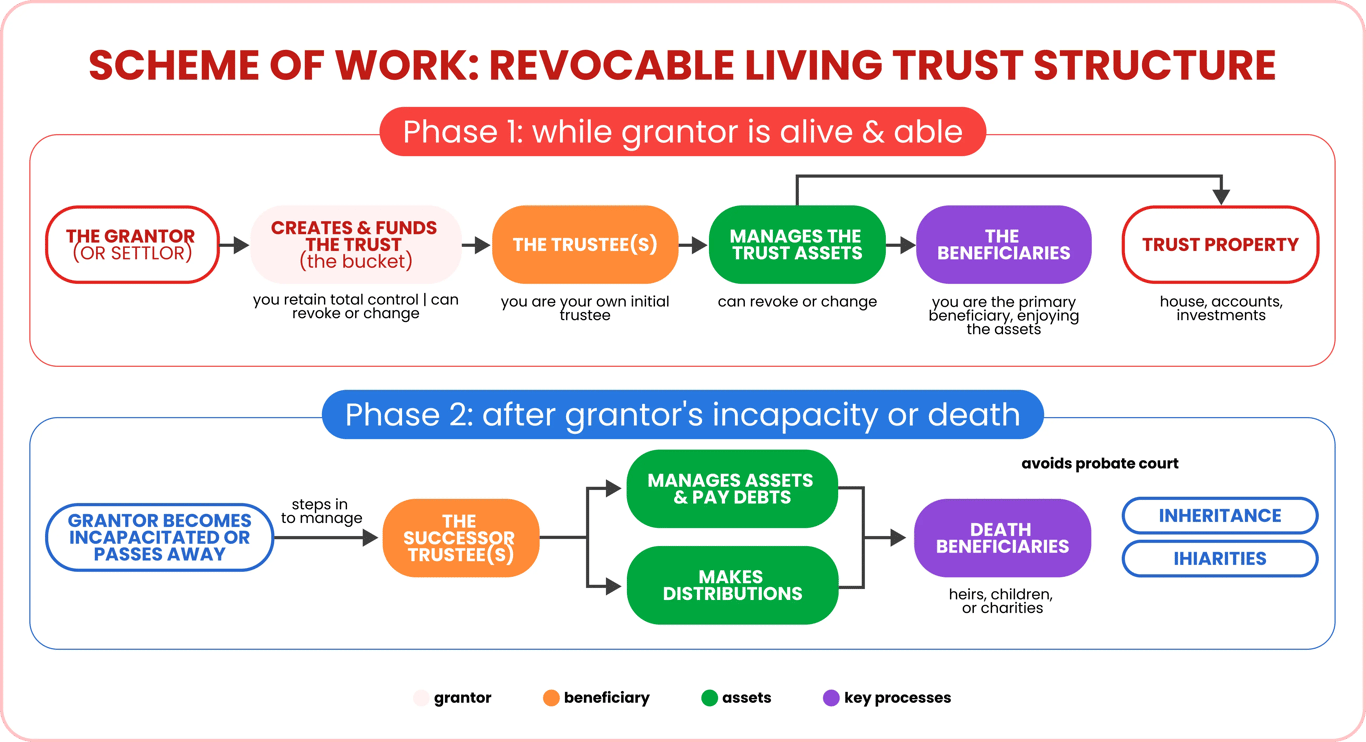
A revocable living trust is a fiduciary arrangement that allows the owner of assets to bundle their assets under one trust and distribute legal and beneficial ownership of those assets. You can think of it as a legal bucket. You can put your assets (e.g., bank account, property, investments, etc.) into this bucket throughout your lifetime and legally entitle selected people to manage them and receive financial and economic advantages. The “revocable” part means that you maintain full control over the trust and assets in it – you can add more assets, take them out, change legal and beneficial ownership and other rules, and terminate the trust at any time during your lifetime. When you pass away, the trust with all its assets gets handed directly to the entitled people according to the previously established trust deed rules.
There are three major roles in a revocable trust:
Grantor (or settlor) – The creator of the trust. This is the person who transfers assets into a trust, takes them out, and sets the rules on who (and how) can manage and benefit from the assets.
Trustee – The manager of the trust. This person is responsible for looking after the assets in the trust, making decisions about them, and ensuring that the trust is handled according to the written rules. Most often, the grantor of the trust is also a trustee until they are alive and physically/mentally capable of managing the trust. It’s possible to appoint a “successor trustee” – a trusted individual (e.g., a child or spouse) or a professional/corporate fiduciary (e.g., a trust company or bank). A successor trustee will assume the role of trustee when a grantor can no longer fulfill it, for example, in the event of disability or death.
Beneficiary – The person who gets the benefits from the trust. During your lifetime, you remain the primary beneficiary who can enjoy the financial and economic benefits of the assets in the trust. After your death, the entitled “Death Beneficiaries” (e.g., heirs, charities, friends, etc.) will inherit the remaining assets. You can also establish inheritance rules; for example, your heirs will gain access to a certain proportion of assets at a specific age instead of inheriting all at once.
Revocable living trusts have several purposes. One of the biggest is the possibility to avoid lengthy and expensive probate court proceedings – with a trust, assets can be transferred to beneficiaries quickly and privately, without involving a court. Also, trusts provide a clear legal framework for managing finances and assets in the event of the grantor's serious illness, injury, or disability.
How a Revocable Living Trust Works
A revocable living trust works in two phases:
Phase 1: while the grantor is alive and able to manage their assets and trust independently. The grantor creates a trust and locates their assets in it (this process is called funding). During the first phase, the grantor typically remains their own trustee and beneficiary.
Phase 2: after the grantor becomes incapable of managing the trust or passes away. The successor trustee steps into the role of a trustee and undertakes the management role. They can manage assets, pay debts and bills, and distribute the assets between beneficiaries according to the trust deed. After the grantor’s death, the beneficiaries gain direct access to the remaining trust assets, without going through probate court.
Pros and Cons of a Living Trust
A revocable living trust can be a good legal tool for managing your assets if you are incapacitated and distributing them after your death without probate. Yet, it has certain limitations and might not be suitable for all situations.
Benefits of a Living Trust | Helps bypass probate. A living trust transfers assets directly to your beneficiaries without involving the courts. This could mean significant time and financial savings for beneficiaries because the average duration of a probate court case is 9 to 24 months, and the total cost can reach 4% to 7% of the estate’s gross value. |
|---|---|
Disadvantages of a Living Trust | Higher legal costs. Unlike a will, establishing a revocable living trust requires more complex legal drafting. On average, the services of an estate planning attorney can cost you between $1500 and $4000 for a standard bundle. However, the cost can be higher in complex cases. The complexity of this procedure often also means more time is needed to set up the trust. |
Benefits of a Living Trust | Incapacity planning. If you become physically or mentally unable to manage your assets, your family members or trusted fiduciary will need to obtain a court-appointed guardianship before they can access your assets. A living trust lets them step into the trustee role immediately. |
|---|---|
Disadvantages of a Living Trust | A lack of asset protection. Since you remain the primary beneficiary during your lifetime, the assets in a revocable trust are still considered yours and are not protected from lawsuits, divorce proceedings, and creditors. |
Benefits of a Living Trust | Increased privacy. During a traditional probate procedure, your will (including the list of your assets and heirs who receive them) becomes public record. Trust documents are usually strictly confidential and don’t allow the general public (except your trustee(s), beneficiary(s), and bank) to see what you owned and who got it. This creates a greater level of privacy. However, privacy can be lost in cases involving real estate transactions, litigation and disputes, trustee/beneficiary requests, or the transfer of a bank or brokerage account into the trust. |
|---|---|
Disadvantages of a Living Trust | The need for funding. A trust can only function when you actively transfer assets into it. If you don’t re-title some of your assets in the name of the trust, they will remain subject to probate. |
Benefits of a Living Trust | Full flexibility. The main benefit of a revocable trust is that you can alter, amend, or terminate it at any time during your lifetime. |
|---|---|
Disadvantages of a Living Trust | No tax benefits. Since you remain in control over the trust assets, they are not removed from your taxable estate (as is the case with an irrevocable living trust) and don’t provide you with income or estate tax savings. |
What Goes Into a Revocable Trust
A revocable living trust form covers the following core sections:
Grantor information: Provides the full legal name and mailing address of the grantor at the top of the document. The following two subsections specify the current marital status, the spouse's full name, and the number of children (if any), along with their names and dates of birth.
Trustee: Appoints an individual who will act as a trustee during the grantor’s lifetime.
Successor trustee: Appoints a successor trustee who will step in after the grantor’s death.
Successor trustee’s bond: Specifies whether a particular trust requires a bond – an insurance policy meant to protect trust beneficiaries from any financial loss that results from a trustee’s negligence or fraud.
Beneficiaries: Lists all beneficiaries who will gain access to the residual estate after the grantor’s death and their shares.
Specific distributions: Clarifies how and when the successor trustee must make distributions to the beneficiaries after the grantor’s death. Common options include:
Outright distributions – The assets are released immediately.
Staged distributions – Beneficiaries receive assets at staggered ages.
Discretionary distributions – The assets are released at the trustee’s judgment.
H.E.M.S. provisions – The trustee distributes assets for Health, Education, Maintenance, and Support purposes.
Spendthrift clause: Specifies whether a given trust in any way restricts beneficiaries from mismanaging the estate; for example, beneficiaries might be banned from pledging or borrowing against their expected inheritance before it’s officially distributed.
Powers of the trustee: Details which specific assets (and in which quantities) the trustee can manage. Apart from managing bank accounts, assets, and distributions, this clause can also give the trustee the authority to make gifts from the trust, hire consultants, enter into legally binding contracts, handle taxes, etc.
Trust for minors: Clarifies if the trustee will have to establish a separate trust for a beneficiary who is under 18 at the moment of the grantor’s death, continue acting as a trustee, or transfer the share of the minor beneficiary to their parent or guardian.
Predecease: Explicitly states what happens to the beneficiary’s share if they don’t survive the grantor by more than 30 days. Often, the share is distributed equally among other beneficiaries or is transferred to the deceased beneficiary’s heirs-at-law.
Trustee’s compensation: Determines whether the acting trustee should receive a fee for carrying out their duties.
Trust for pets: Clarifies if the grantor has any pet beneficiaries. If yes, assigns the pet trustee, provides the information about the pet, states the amount of money that must be available to the pet, and outlines the main responsibilities and rights of the pet trustee.
Grantor provisions: Provides a set of clauses that establish the grantor as the ultimate controller of the trust and communicate that the grantor can request payments, take out assets, and otherwise amend the trust during their lifetime. This section also clarifies what shall happen in the case of the grantor’s incapacitation or death, and provides an explicit explanation of what incapacitation means.
Rights of beneficiaries: States the rights and authority the beneficiaries have in terms of accessing trust property, demanding accounting records, and appointing new trustees if the acting trustee resigns or fails to perform their duties.
Additional trust provisions: Provides additional rules on when and how the trust assets can be used. For example, this clause can require a trustee to cover the grantor’s debts, medical bills, and funeral expenses from the trust before distributing the assets to beneficiaries.
Revocation: Explicitly states the grantor’s right to revoke or amend the trust at any time during their lifetime, while not under a disability.
Governing law: Specifies the jurisdiction that will govern the trust (usually the state of the grantor’s residence).
Severability: Clarifies that if any provision of the trust or its application to persons or circumstances will be determined invalid, the rest of the trust provisions remain valid and enforceable.
Grantor's signature: The formal space where the grantor has to sign the document, type their full name, and add a date of signing.
Self-proving affidavit for a revocable trust: A formal statement provided by the grantor that confirms that the trust was duly established and executed on the indicated date. The purpose of the statement is to affirm the validity of the trust. Depending on the jurisdiction, it might need a witness attestation or a notary acknowledgment.
Property attachment: A list of assets and property that the grantor agrees to convey, transfer, or assign to the trust.
In addition to the complete revocable living trust document, it’s recommended to create a certification of revocable trust. A certification is a short, legally binding summary of the full document that affirms the trust’s existence and summarizes its key provisions without sharing sensitive information, such as beneficiary names or asset distributions. This document can come in handy when a trustee engages with a third party, for example, a bank to open an account or a real estate agent to sell property. In such events, the third party may require proof of the trustee’s authority, and a certification of trust provides it, keeping sensitive information protected.
How to Create a Revocable Living Trust
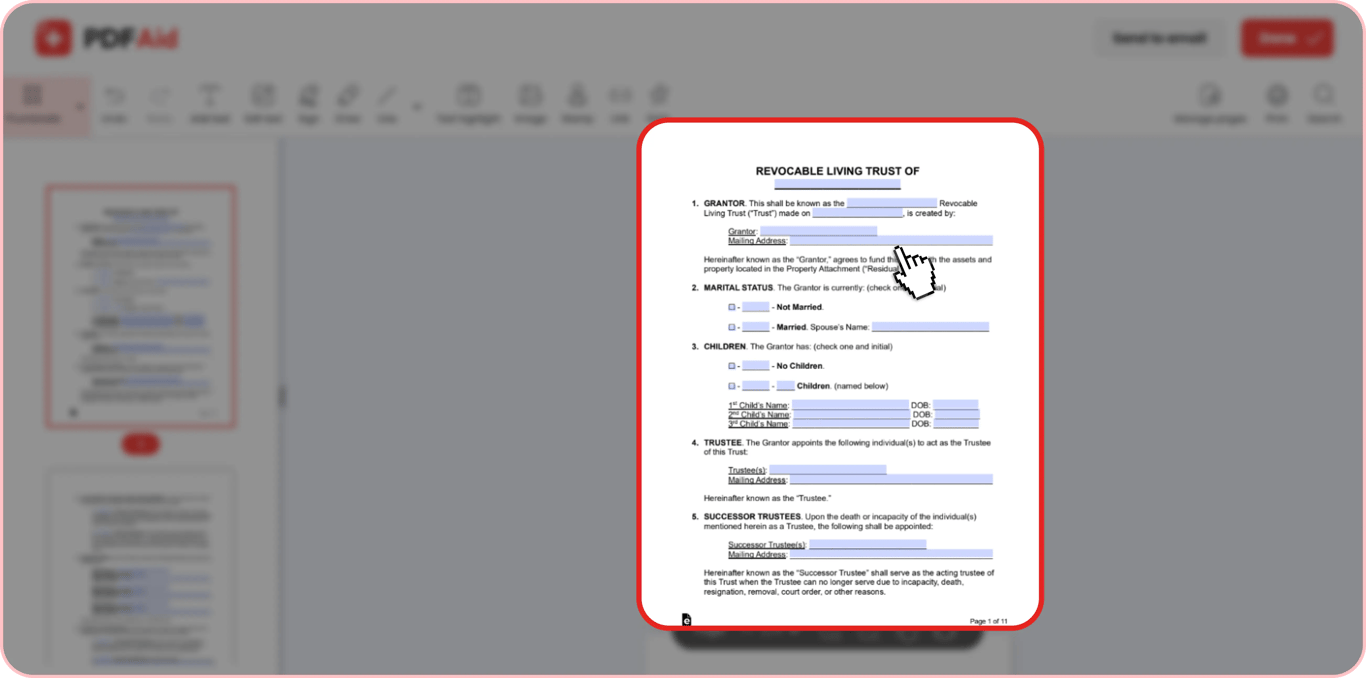
You can create a revocable living trust in several ways: with a printable template, with a template and an online editor, or with an estate planning attorney. Using our PDF editor and revocable living trust template is the easiest and fastest way – you only need to fill in the empty fields with your information and add your signatures, without installing any special software. What you’ll need to use our form:
Grantor’s details
Successor trustee information
Beneficiaries data
Asset data
Step-by-Step: Filling Out the Form
When you have all the necessary data, follow these steps to set up a revocable trust with our template and editor:
Step 1. Go to a Revocable Living Trust form page on our platform and click “Get Form.” The editor will instantly open the template, ready to fill in.
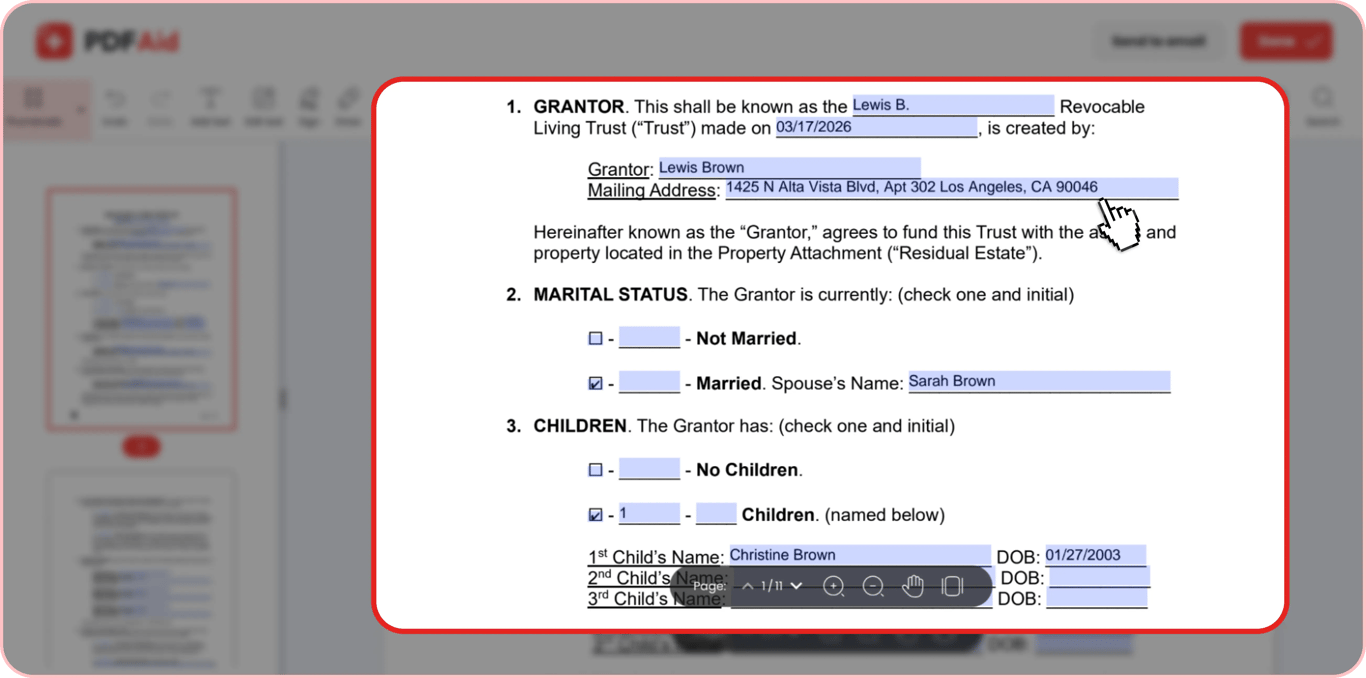
Step 2. Type the name of your trust and the date of its creation at the top of the page. Then, fill in the grantor’s full name and mailing address. Check one of the two boxes to demonstrate the grantor’s marital status and provide the spouse’s full name if married. Check one of the two boxes to indicate whether the grantor has kids; then type the number of kids, their names, and their dates of birth.
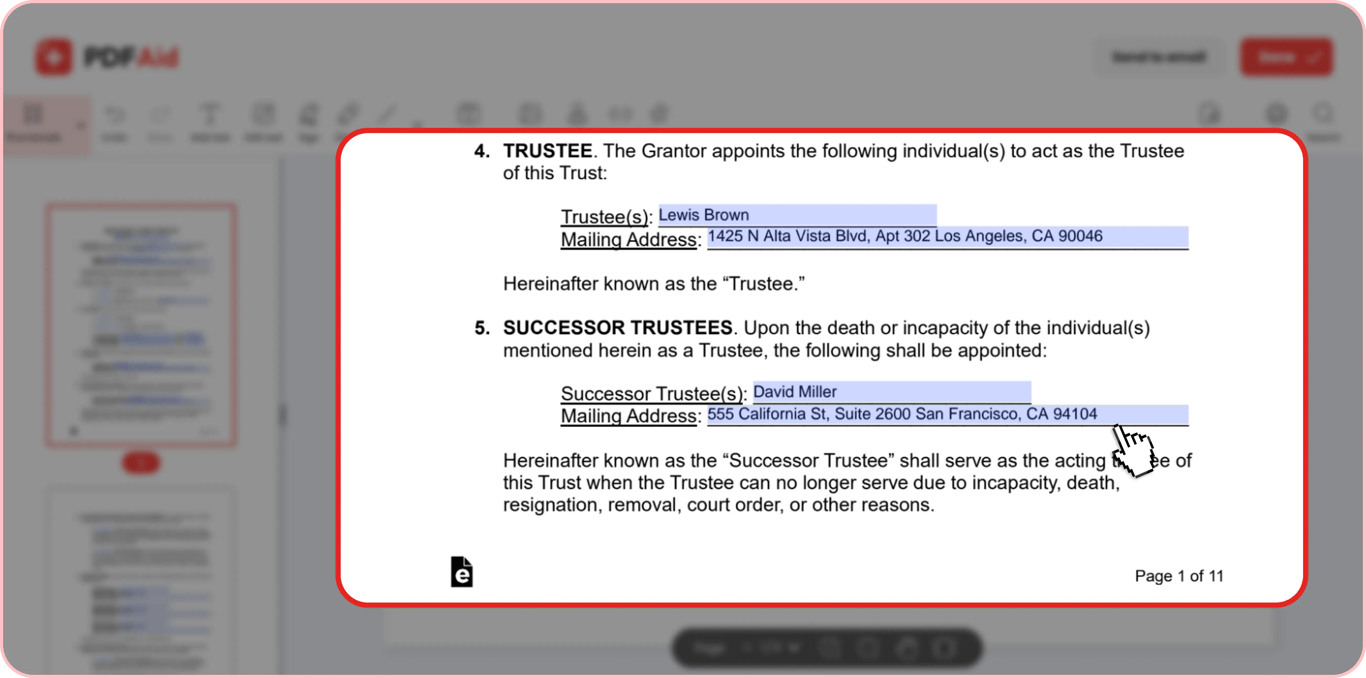
Step 3. Fill in the Trustee and Successor Trustee sections by providing full names and mailing addresses. You can indicate yourself (a grantor) as a current trustee and assign a trusted person as a successor.
Step 4. Check one of the two boxes to indicate if there is a bond requirement.
Step 5. Fill in the Beneficiaries section. Indicate the full name, share of residual estate, and mailing address for every beneficiary.
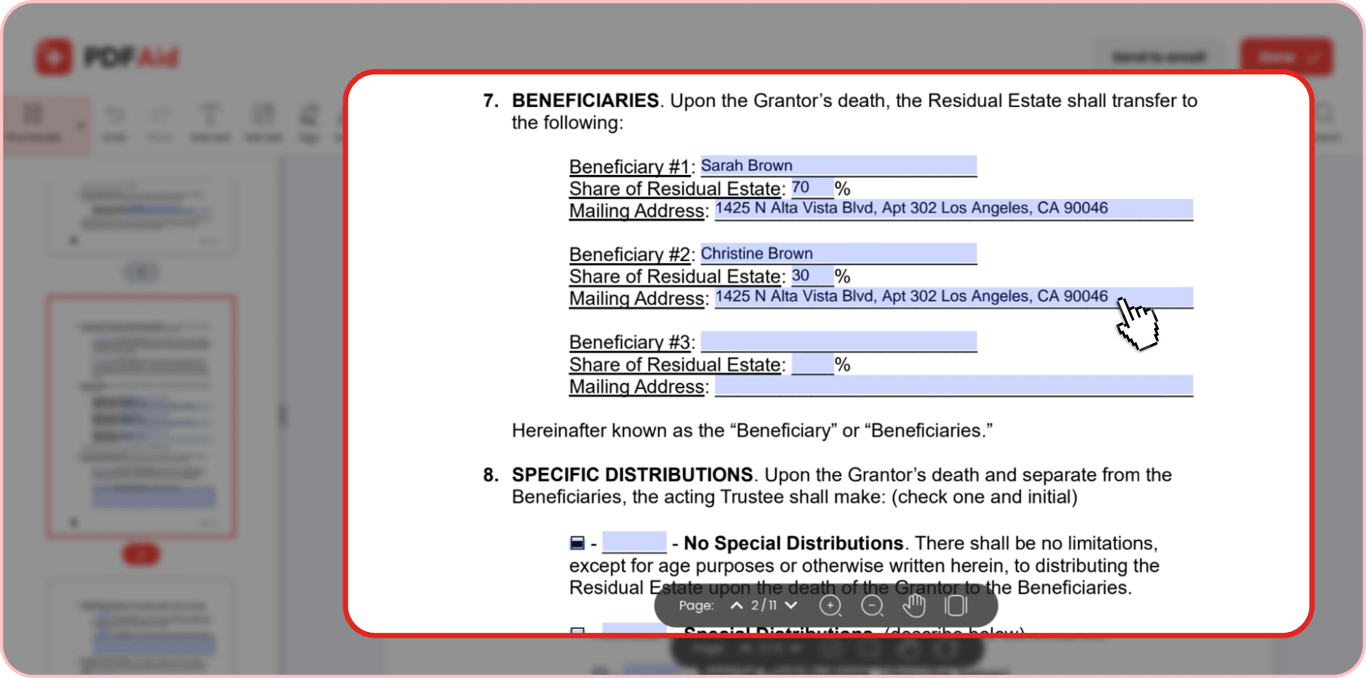
Step 6. Check the appropriate boxes in sections Specific Distributions, Spendthrift Clause, Powers of the Trustee, Trust for Minors, Predecease, Trustee’s Compensation, and Trust for Pets at your discretion. Provide additional details, rules, and limitations where applicable.
Step 7. Complete the Self-Proving Affidavit for a Revocable Trust.
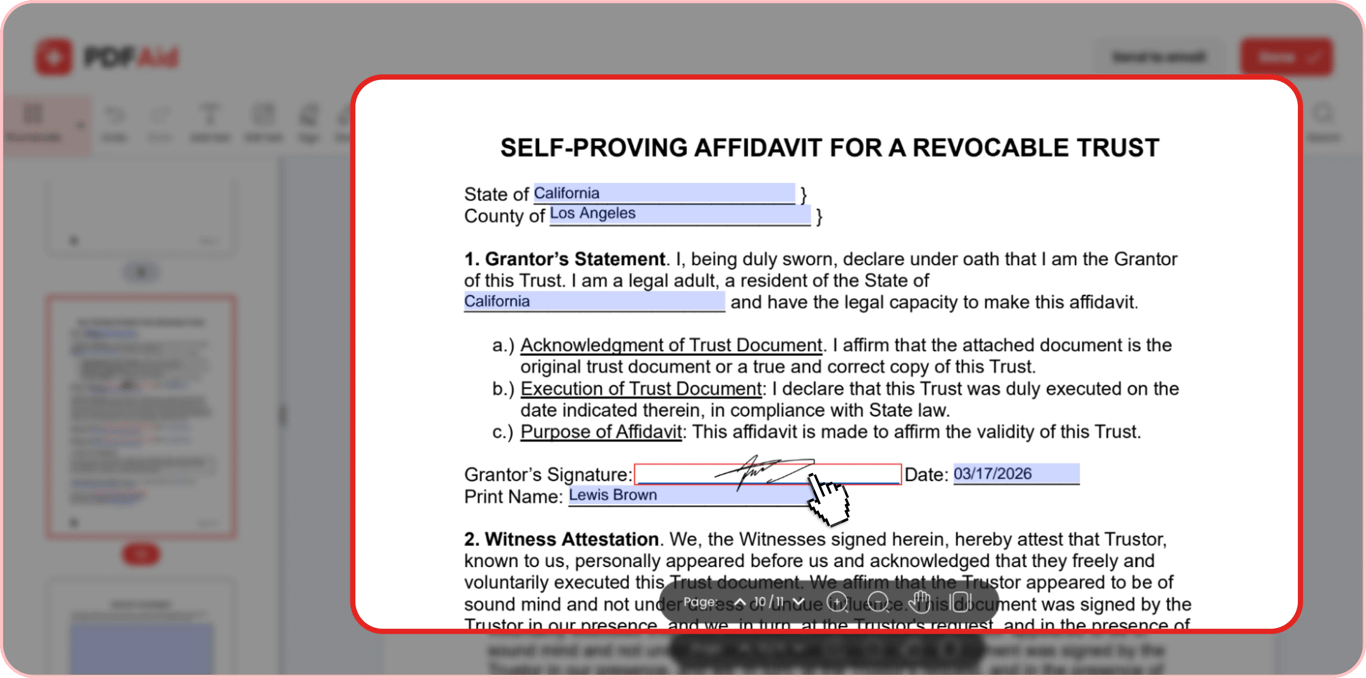
Step 8. Complete the Property Attachment section, listing all the assets you plan to transfer into the trust.
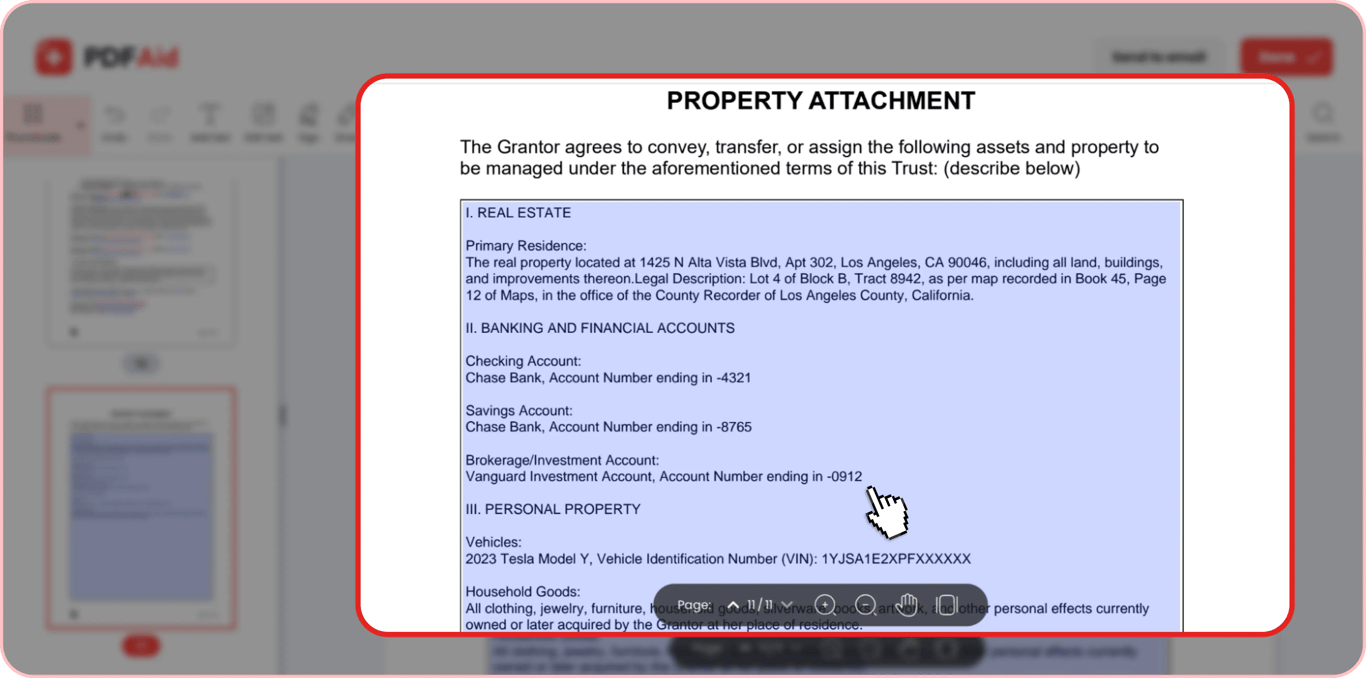
Step 9. Carefully check all the document’s provisions and the data you filled in for correctness before signing.
How to Make a Living Trust Without a Lawyer
Creating a living trust without legal help sounds like a good choice if you want to reduce upfront costs. It is also quite a realistic task if you have a simple estate situation, such as a small number of assets (e.g., one house, several bank accounts, and responsible adult heirs). To do this, it’s enough to use a current legal template of a living trust document and an intuitive PDF editor to fill it in.
The main thing in the DIY approach is strict adherence to formalities. You want to use accurate information and carefully comply with your local laws so that your document has full legal force and your beneficiaries won’t have to deal with courts after your death.
Here’s a practical checklist to create a legally sound revocable living trust:
Check your state laws before drafting. Formation rules and witness/notarization requirements vary from state to state, and you need to comply with your local jurisdiction to establish a trust.
Clearly identify a successor trustee. Assign a reliable successor and collect their data (full name and mailing address) to fill in the template.
Make an accurate list of your assets. The Property Attachment (Schedule A) must provide a detailed description of the property you will transfer to the trust. Information to include:
Full address and legal description for real estate.
Institution name, account type, account number, and approximate balance/value for bank accounts.
Entity name and ownership details (share, total number of shares, and type of stock) for business and investment interests.
Model, year, and VIN code for vehicles.
For other personal items: either list specific high-value items (e.g., jewelry or antiques) or include a blanket statement that attributes all other tangible personal property items to the trust automatically.
Follow the witness/notarization requirements when signing. Refer to your state’s laws to ensure that your document is signed legally correctly.
Don’t forget to fund your trust. For your living trust to start operating, you need to physically re-title your assets to the name of the trust.
When to work with an estate planning attorney instead of doing it yourself:
When the value of your estate exceeds the federal Estate Tax thresholds. These thresholds are attached to the specific year of death, but checking the latest thresholds can give you an idea of estate value limits to keep in mind.
When your family dynamics aren’t straightforward, for example, you have one or several ex-spouses, children from previous marriages, etc.
When your assets include commercial real estate, business, foreign bank accounts, or property outside the United States.
When you want to establish long-term payment terms and rules, for example, when leaving an inheritance to minors.
How to Sign and Notarize Your Trust
After completing the form, you need to sign it so that it comes into legal force. Follow these steps to sign your document correctly:
Step 1. Check the witness/notarization requirements in your state. The rules can vary significantly; for example, New York and Florida require the presence of two witnesses to affix signatures. Notarization of trusts is a common practice in these states too, though not statutory.
Step 2. Create the right conditions for signing. Depending on your state, invite a notary public and/or witnesses.
Step 3. Open the completed form in our editor and scroll down to the Grantor’s Signature block.
Step 4. Type your full name and date of signing.
Step 5. Click on the Sign tool and draw, upload, or type your signature. When the signature appears on top of the form, resize it and place it in the relevant box.
Step 6. Click Done in the upper-right corner, then export the signed document as a PDF.
Get the most current Revocable Living Trust Documentation - Assets, Estate, and Trustee Details form now
Up-to-date • Fillable • Ready to sign online